


























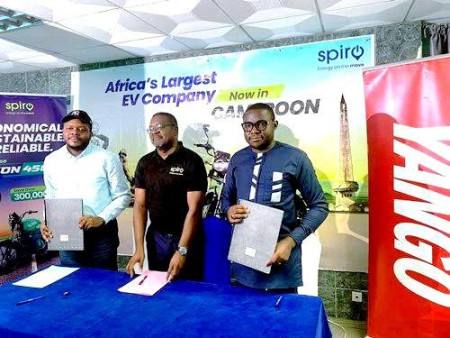
Indian electric motorbike maker Spiro signed a partnership on April 29, 2026, in Douala with Royal Holding, a partner of Yango, to deploy an initial fleet of 40 electric motorbikes in Cameroon’s economic capital. Operations are set to begin on May 4, according to the parties.
The agreement aims to integrate Spiro’s motorbikes into the transport services offered through the Yango ecosystem. For Spiro, this move serves as a test of its electric mobility model in a city where motorbikes play a central role in daily transport but face rising fuel and maintenance costs.
The company says it has already installed 15 battery swap stations in Douala. This network is designed to address one of the main barriers to electric vehicle adoption: range. Instead of waiting for batteries to recharge, riders can swap depleted batteries for charged ones at designated stations.
“This strategy aims to reduce concerns about battery range by offering a lower operating cost than fuel-powered bikes, estimated at CFA1,500 per 100 kilometers,” said Alain Guy Etoundi, managing director of Spiro Cameroon.
The project will first be tested in Douala, with planned expansion to Yaoundé in June and Bafoussam in the fourth quarter. Spiro then aims to extend operations to northern and eastern regions by 2027, with the goal of covering the entire country by 2028.
For Royal Holding, the partnership is expected to expand the Yango fleet and improve service speed. Frank William Biboum, managing partner at Royal Holding, also highlighted electric motorbikes as a way to reduce drivers’ operating and maintenance costs.
According to the companies, electric motorbikes could cut operating costs by half compared with conventional bikes. They estimate that drivers could earn up to CFA300,000 in additional annual income, depending on activity levels, battery costs, maintenance, and operating conditions.
In the medium term, Spiro plans to build an electric motorbike assembly plant in Cameroon. The facility would support network expansion, improve maintenance, and allow faster response to user demand.
The partnership with Royal Holding represents a key test for electric mobility in urban transport in Cameroon. Its success will depend on several factors, including battery reliability, the density of swap stations, actual costs for drivers, after-sales service, and user adoption.
In a context of volatile fuel prices, electric motorbikes could offer a cost-saving alternative for some drivers. However, the model will need to prove viable beyond the initial 40-bike pilot and demonstrate that projected gains can be achieved in real operating conditions.
Frédéric Nonos

