


















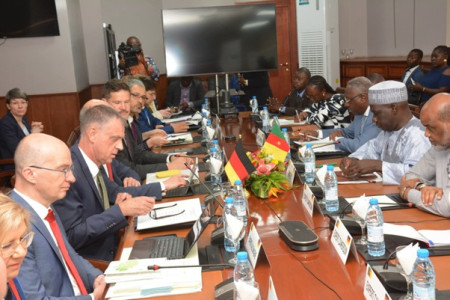
Cameroon and Germany have agreed to refocus their bilateral cooperation on private sector mobilisation and value chain development, following intergovernmental talks held in Yaoundé on April 27–28.
The negotiations resulted in a financing package of 58.43 billion CFA francs (€89.2 million) for the 2025–2026 cycle.
The agreement, signed between Cameroon’s Ministry of Economy (MINEPAT) and Germany’s Federal Ministry for Economic Cooperation and Development (BMZ), reflects a shift toward greater reliance on private investment to scale the partnership.
The new funding continues an upward trend in German support. Financing stood at about €50 million in 2020–2021 and rose to €75 million in 2023. The latest allocation will target priority sectors including health, agriculture, rural development, governance, decentralisation, social cohesion and sustainable natural resource management.
Germany’s total cooperation portfolio in Cameroon now exceeds 320 billion CFA francs, spanning nearly 70 years.
Germany has reaffirmed its commitment despite a challenging implementation environment, said Economy Minister Alamine Ousmane Mey, adding that both sides agreed to maintain a stable cooperation framework.
ProMote 2026 to anchor private sector push
The shift toward private sector involvement is expected to take shape in June 2026, when Cameroon hosts ProMote, a business forum bringing together Cameroonian and German firms.
The event aims to translate bilateral ties into concrete investment projects, with a focus on strengthening trade and industrial links.
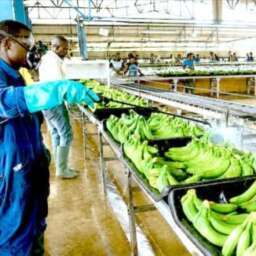
BMZ Africa Director Philipp Knill said agricultural and livestock value chains would be central to the strategy, linking the approach to current global supply disruptions.
Strengthening domestic value chains would support import substitution and improve resilience to external shocks, he said, citing disruptions linked to the Strait of Hormuz.
Knill also pointed to a separate 2024 agreement mobilising $2.5 billion (about 1,402 billion CFA francs) through 2035 for forest protection and forestry value chain development, complementing the new funding cycle.
Both governments said they would maintain cooperation priorities including peacebuilding, governance reforms, natural resource management, health programmes, anti-corruption efforts and human rights.
The new cycle is aligned with Cameroon’s National Development Strategy (NDS30), which aims to make the country an emerging economy by 2035. Civil society is expected to play a role in implementation.
Mercy Fosoh

