





















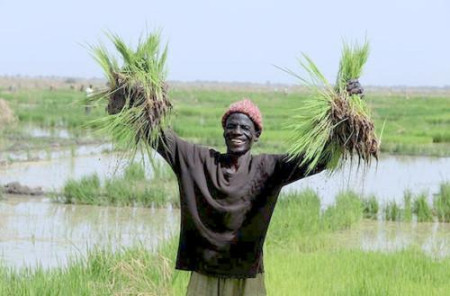
The African Development Bank (AfDB) has approved an €81.2 million ($94 million) loan to help Cameroon develop irrigation infrastructure in its northern region, supporting a broader strategy to strengthen agricultural production and climate resilience.
Combined with an expected €7.54 million ($8.7 million) contribution from the Cameroonian government, the first phase of the Northern Agro-Industrial Development Program (PDAS-1) will cost €88.74 million (about $103 million).
The financing, approved on July 13, 2026, will fund the construction of three multi-purpose hillside dams and the development of 618 hectares of irrigated farmland. According to a procurement notice published by Cameroon’s Public Procurement Regulatory Agency in March, the dams will be built in Barkehi, in the municipality of Gashiga within Demsa district; Ndjam-Badi, in Bibémi district; and near Poli in the Faro department around villages in the Mango canton. The three sites were selected from five locations studied.
The infrastructure is intended to sustain farming and livestock activities during the region’s long dry season. The reservoirs will also support livestock watering, fishing, and improved water availability.
Authorities are also studying whether the stored water could be used to supply nearby communities with drinking water. A consulting firm was sought earlier this year to assess local needs, existing infrastructure, and technical options, meaning that component remains under evaluation.
More than an irrigation project
Based on the total project cost, the investment amounts to roughly CFA94.2 million per irrigated hectare.
That figure, however, goes well beyond the cost of irrigation infrastructure alone. The financing also covers the construction of three multi-purpose dams, water storage and distribution systems, hydraulic equipment, engineering studies, construction supervision, environmental and social measures, livelihood restoration for affected communities, and overall program management. Although the project’s primary objective is agricultural development, the AfDB classifies PDAS-1 under the water and sanitation sector because of its broader focus on water resource management.
The program is expected to generate activity in hydraulic engineering, civil works, environmental consulting, solar-powered irrigation, irrigation management, and agricultural processing. In practice, it is designed as a multi-purpose water, agriculture, and climate resilience project rather than a simple land development scheme.
Project costs remain to be detailed
The AfDB’s approval announcement does not specify how the financing will be allocated among the dams, irrigation works, equipment, engineering studies, compensation payments, and project management.
A full assessment of the project’s efficiency will require additional information, including the storage capacity of each reservoir, the volume of water available for irrigation, the cost of distribution networks, the number of beneficiaries, and future operating and maintenance expenses. At the Poli site alone, environmental and social measures are estimated at about CFA1.08 billion, including nearly CFA387 million in compensation for lost assets.
The project will require land acquisition, compensation for lost crops, and the involuntary resettlement of some affected households, factors that could influence the implementation schedule. Environmental and social monitoring at Poli is expected to continue for 44 months, while the timetable for compensation payments, site preparation, and construction has yet to be finalized.
A first step toward a much larger program
The AfDB financing covers only the first phase of the initiative. A second phase envisions the construction of larger multi-purpose dams capable of storing about 500 million cubic meters of water and irrigating more than 40,000 hectares—roughly 65 times the area covered under the current project. That expansion is not included in the €81.2 million loan, and the AfDB has not disclosed its cost, timetable, or potential financing partners.
As a result, PDAS-1 is best viewed as a pilot phase intended to test rainwater harvesting, irrigation management, and the development of year-round agricultural activities around the reservoirs. According to Léandre Bassolé, the AfDB’s Director General for Central Africa, the program is intended to help Cameroon unlock its agro-industrial potential, create jobs, strengthen communities’ climate resilience, and attract private investment.
Ultimately, the project’s success will be measured by more than the number of hectares brought under irrigation. Key indicators will include the cost of mobilized water, infrastructure reliability, gains in agricultural productivity, growth in farm incomes, and the long-term maintenance of the facilities.
Baudouin Enama

