



















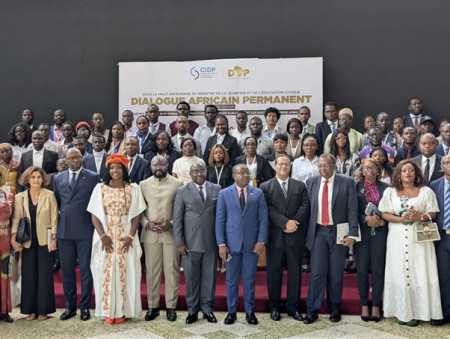
The first edition of the Permanent African Dialogue (PAD) was held on April 28, 2026 at the Yaoundé Conference Centre, bringing together more than 400 participants from governments, international institutions, investors and civil society. The event focused on structuring and financing youth systems as part of a new economic approach to migration, with the objective of developing bankable projects and policy frameworks.
Held under the patronage of Cameroon’s Ministry of Youth and Civic Education, with support from the International Organization for Migration (IOM), the initiative—led by the International Council for Dialogue and Partnership (CIDP)—aims to reposition migration as an economic dynamic to be organised rather than controlled. The approach centres on building systems that mobilise capital, develop skills and structure labour mobility across Africa.
Discussions highlighted the need to move beyond fragmented programmes toward scalable financing mechanisms targeting Africa’s youth, who represent over 60% of the population. The emphasis was placed on integrated systems linking education, employment, mobility and investment.
CIDP Coordinator Hemes Nkwa said the priority is to channel large-scale financing into structured youth systems capable of training and integrating talent. He stressed that current funding approaches remain insufficient in scale and coordination relative to demographic pressures.
The programme included policy panels, technical workshops and a hackathon aimed at generating investment-ready projects aligned with public priorities. Exhibition spaces connected youth-led initiatives with potential financial and technical partners.
Migration reframed as economic infrastructure
Participants called for the integration of migration into broader economic planning, including labour market development, skills recognition and cross-border mobility systems. The PAD seeks to contribute to coordinated policy frameworks at national and international levels.
IOM’s Chief of Mission in Cameroon, Abdel Rahmane Diop, said migration should be managed as a structural economic reality, stressing the need to create safe and regulated mobility pathways.
The dialogue aligns with Cameroon’s efforts to develop a national migration policy and references broader frameworks such as the Sustainable Development Goals and Agenda 2063.
From policy discussion to implementation
Government representatives underscored the need for systems capable of absorbing young people into the economy while structuring migration flows to generate value.
Secretary General Zachée Robert Théophile Benga, representing the Minister of Youth, said Africa’s demographic profile requires robust systems to support economic integration and talent development.
The PAD is intended as a permanent platform. Outputs from the inaugural session will include a White Paper with policy recommendations, alongside a roadmap to guide implementation.
Organisers indicated that follow-up mechanisms over the next 12 months will focus on translating discussions into bankable projects and tracking commitments.
Mercy Fosoh

