
























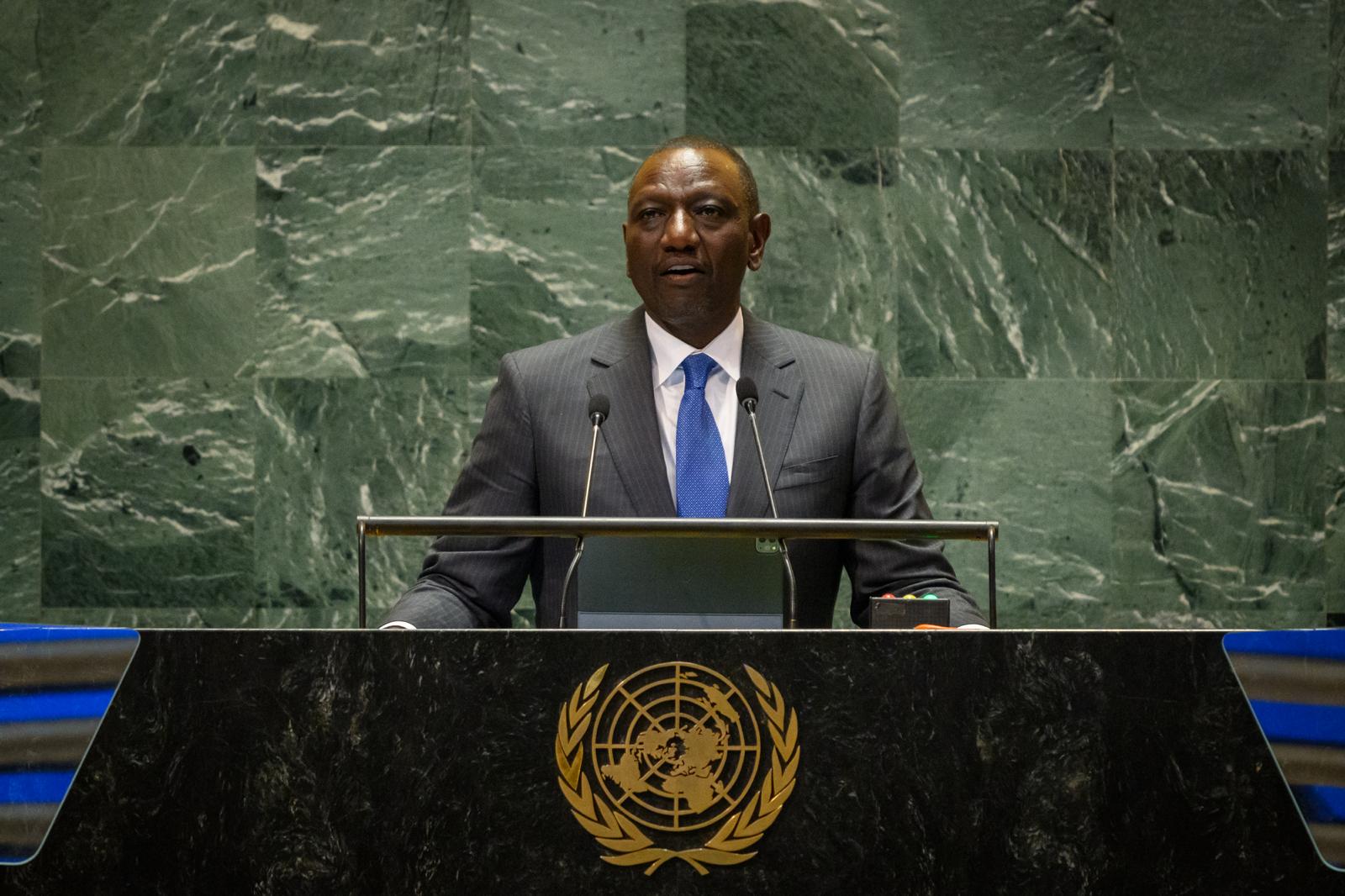
In his September 2025 address at the UNGA80, President William Ruto of Kenya struck a chord by highlighting the UN’s declining credibility: “On peace and security, its voice is too often drowned by the rivalries of great powers, while some nations simply ignore its resolutions and do as they please.”
This was not rhetorical exaggeration, but a diagnosis of broken global governance, with Africa paying the highest price. The UN’s mid-20th-century design creaks under the strain of great power rivalries; its enforcement mechanisms remain calibrated to selective politics; and Africa, though a backbone of UN peace operations contributing approximately 45% of all UN peace operations, remains on the margins of decision-making. If the UN is to survive its legitimacy crisis, reform is not an option — it is an existential imperative.
We are witnessing the warning signs all around us. In Sudan, the siege of El Fasher has dragged on, with hundreds of thousands stranded, aid cut off, and civilians paying the worst price. The UN has raised alarm after alarm, but diplomacy has repeatedly failed to bring relief. Within the Council, Russia vetoed a Sudan resolution in November 2024 — as some Council members and civil society called for urgent action to protect civilians. The African Union, with its suggested plans such as the Ezulwini Consensus, has long been championing structural reform, including permanent African membership in the Security Council. Yet, years of indolence and resistance persist. To restore credibility — especially in Africa — the UN must confront three structural challenges and pursue a focused reform path.
Mounting Obstacles: Rival Powers, Weak Enforcement, and Africa’s Exclusion
I. Security Council paralysis fuelled by great power rivalries
The structure of the UN Security Council — five permanent, veto-wielding members and ten rotating non-permanent seats — provides great powers with disproportionate control over whether the Council speaks or remains silent. In crises where timely collective action is critical, vetoes, abstentions, and rival drafts often turn the Council into a diplomatic bottleneck.
Sudan illustrates this paralysis – in November 2024, Russia vetoed a draft to improve the protection of civilians, despite overwhelming support from the other members and an unambiguous humanitarian imperative. The veto remains a blunt instrument allowing bilateral interests to override collective responsibility.
A similar problem is the selective implementation of Council instruments. Aside from showing selective attention to conflicts, resolutions may demand arms embargoes, sanctions, or peacekeeping missions — but their implementation is a function of political will, not automatic enforcement. Major powers, when they see that these resolutions conflict with their strategic interests, can subvert mandates. This tends to make the council into a “toothless bulldog.”
- Enforcement gaps and the habit of impunity
Even when the UN does adopt binding resolutions, powerful states often evade or ignore them. The UN lacks a dependable, depoliticized method for punishing non-compliance.
In Sudan, for example, the El Fasher siege persists in defiance of repeated UN calls for corridors, ceasefires, and access by humanitarian agencies. The Rapid Support Forces (RSF) have been deaf to diplomatic pressure, blocking aid routes and upping hostilities. Civilian areas have been shelled, despite the urgency, the UN’s statements and resolutions have not so far been fully respected, especially by the warring parties.
Meanwhile, external actors who supply weapons, funds, or political protection to fighters are rarely sanctioned, although their support causes grave suffering and violations by sustaining the war. Based on the lack of regular and transparent standards for follow-up — and without automatic accountability — the UN’s assertions risk being dismissed as empty rhetoric.
- Africa’s paradox: troop contributor, but marginalized voice
Africa contributes a disproportionate level of UN peacekeepers and civilian personnel. African states bear the costs of conflict yet remain excluded from permanent decision-making. The continent’s long-time exclusion from permanent membership in the Security Council is increasingly an anachronism that speaks against its legitimacy, and for this reason, in his address, William Ruto added that “you cannot claim to be the United Nations while disregarding the voices of 54 nations.”
The African Union, using assistance from tools like the Ezulwini Consensus, has long been calling for at least two African permanent seats, but the post-1945 arrangement has turned out to be extremely resistant to modification. It was not until 2024 that the USA decided to push for two African permanent seats — on the proviso, however, that the new seats would not have veto powers. That proviso is a pointer to how entrenched the vested interests are in not diluting the prerogatives of the existing permanent five.
It erodes legitimacy: when crisis on the continent takes center stage — famine, civil war, state collapse — those most impacted see decisions taken by distant powers that all too often seek to use Africa as a theater, not a partner. Unless African nations wield real institutional power, the UN will continue to be viewed as a forum for great powers, rather than a global governance body for all.
Recommendations: Rebuilding a Credible UN for Africa and Beyond
To address the UN crisis identified by William Ruto, we must move from rhetoric to structural reform through these three interlocking policy paths:
I. Reform the Security Council
- Expand permanent African representation.An equitable and credible reform should grant African states at least two permanent seats at the UNSC. The U.S. support for two African permanent seats (albeit without veto rights) indicates a potential political opening that should be leveraged for equal representation.
- There should be a restricted veto use in atrocity cases. Any reform package must include “veto restraint” or automatic override for genocide, ethnic cleansing, or large-scale mass atrocities. This would enable action collectively despite the objection of one permanent member on less broad strategic grounds.
- Incremental implementation.Conscious of the political difficulties associated with charter amendments, incremental implementation would begin by adding non-permanent seats with rotating “quasi-permanent” status, in addition to binding rules on decision thresholds, before proceeding to full permanent enlargement.
II. Institutionalize AU-UN operational partnership
- Joint rapid-response mechanism.Establish a joint AU-UN Rapid Reaction Fund, funded in advance and linked to UN budgets, so that it can be deployed instantly in case the Security Council is stalemated. This will address the issue of delayed and unfair interventions, as Ruto added in his speech that the Security Council “is unable to act inclusively with fairness, and with speed.”
- Pre-positioned logistics and command protocols.Create joint assets of transport, medical aid, intelligence, and command structures to allow for a quick response by the AU or regional coalitions, legally covered by the UN.
III. Systematize accountability for non-compliance
- Mechanisms for automatic review. Establish laws that institute frequent review and sanction if a state fails to act on Security Council resolutions within a defined timeline.
- Independent investigating bodies. Empower independent bodies of inquiry whose findings contribute directly to enforcement decisions, minimizing politicized veto power.
- Transparent sanctions criteria. Member states must agree to rigorous, publicly declared standards on the imposition of travel bans, freezing of assets, and arms embargoes — and apply them regularly, especially in situations where there is evidence of individuals who fund and support conflict/war in countries.
These recommendations are not without challenges. Early expansion of the Council can deepen polarization; altering veto rules risks upsetting established power, and rebalancing operational and financial burdens will require serious commitment by the member states. But the alternative — ongoing undermining of the UN’s moral authority, and the formation of parallel power arrangements without legitimacy is a far worse outcome
When President Ruto spoke at the UNGA80 and raised concerns that the institution’s voice is being “drowned”, he rang an alarm that resonates throughout Africa and the globe. Functionality today at the UN is not a list of isolated failures — it is a reflection of a system where great-power rivalry replaces common interest, leaves enforcement in the hands of untrustworthy politics, and shuts out from deliberation the very states most affected.
The way forward is clear. By combining Council reform with control of the veto, functional AU-UN modalities, and binding norms of accountability, the UN can recover legitimacy and once again speak out — most especially where it matters most, in Africa’s peace and security crises. If the global community fails this test, the UN risks becoming a relic — abandoned by the people it speaks for and respected only by those who have no will to abide by its decisions. Africa, in particular, cannot afford that betrayal to occur twice.

Enowbachem Agbortanyi
Enowbachem Agbortanyi is a Policy Analyst with the Peace and Security Division at the Nkafu Policy Institute. He holds a Master’s in Political Science from the University of Gothenburg and is a Swedish Institute Alumnus. His work spans roles at Centre for Human Rights and Democracy in Africa (CHRDA), and research contributions to the Varieties of Democracy Institute (V-Dem) and the Governance and Local Development Institute (GLD) both in Sweden.

