





















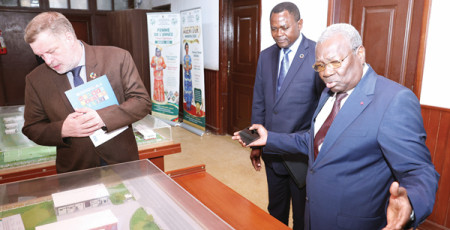
The United Nations Development Programme, UNDP, has pledged support for Cameroon’s efforts to expand local milk processing and reduce dependence on imported dairy products. The commitment was discussed during a meeting between the Minister of Livestock, Fisheries and Animal Industries, Dr Taiga, and the UNDP Resident Representative in Cameroon, Mathieu Ciowela, on July 23, 2026.
The discussions focused on strengthening the country’s dairy value chain through technical assistance for project development, support for local milk processing, and succession planning within pastoral communities. According to UNDP, the partnership is intended to address structural weaknesses that continue to limit domestic dairy production.
The initiative comes as Cameroon seeks to close a significant gap between milk production and consumption. Data from the Ministry of Livestock, Fisheries and Animal Industries show that national milk production reached 176,618 tons in 2023, up 2% from 173,907 tons in 2022. However, domestic demand is estimated at more than 300,000 tons annually, leaving a supply deficit of over 120,000 tons.
According to figures from the National Institute of Statistics cited by Business in Cameroon, the country spent CFAF40.6 billion, in 2023, to import 20,596 tons of milk and dairy products. An additional CFAF35 billion as spent by industries to import 17,217 tons of powdered or concentrated milk aimed at supplementing local supply.
UNDP said its support will focus on improving milk collection, processing and storage systems while helping build the capacity of actors across the dairy value chain. The program is also expected to support the adoption of modern processing technologies and strengthen the commercial viability of dairy farming.
The government identifies low-yield cattle breeds, inadequate cold-chain facilities and limited processing infrastructure among the main constraints affecting the sector. These challenges contribute to post-harvest losses and restrict the volume of locally processed dairy products reaching the market.
Authorities view the dairy sector as a key component of Cameroon’s import-substitution strategy. Beyond reducing expenditure on imported dairy products, increased local processing could create opportunities for livestock farmers, milk collectors, transport operators and agro-industrial processors.
The partnership also aligns with the government’s long-term dairy development strategy. In June 2024, Cameroon adopted a CFAF 305.7 billion dairy sector development plan covering the period 2024-2035. The program aims to increase national milk production to more than one million tons by 2035 and significantly reduce reliance on imported dairy products.
For UNDP and MINEPIA, strengthening local processing capacity and improving productivity remain central to efforts to transform the dairy industry and meet growing domestic demand through local production.
Mercy Fosoh

