

















Cameroon has secured UK-backed financing for the long-delayed Ebolowa-Akom II-Kribi road, removing one of the main obstacles that had stalled a project expected to strengthen access to the Port of Kribi and improve regional trade.
The €198.3 million (about CFA130 billion) financing package for the 162-kilometer highway is backed by UK Export Finance (UKEF), the United Kingdom’s export credit agency, according to a July 7 statement from Standard Chartered Bank. The British lender arranged the financing, which also includes an additional €11.9 million (about CFA7.8 billion) commercial loan not covered by the UKEF guarantee.
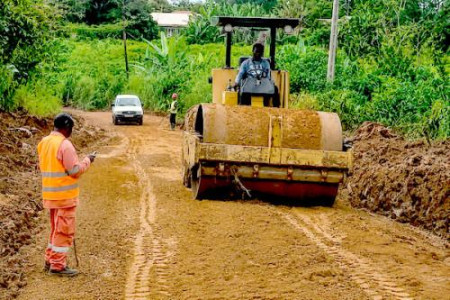
The financing agreement was signed on May 15, 2026, in Yaoundé by Cameroon’s Minister of Economy, Planning and Regional Development, Alamine Ousmane Mey. According to Standard Chartered, the road linking Ebolowa to Kribi through Akom II is a strategic economic corridor for Cameroon’s South Region. Paving the existing dirt road is expected to improve road safety, reduce transportation costs, and facilitate the movement of people and goods.
UK Guarantee Supports British Exporters
Export credit agencies are public institutions that help domestic companies win business abroad by providing loan guarantees, insurance, and financing that reduce commercial and political risks in foreign markets.
In the case of the Ebolowa-Akom II-Kribi project, UKEF’s involvement reflects the participation of British companies in the project’s supply chain.
Standard Chartered said a substantial share of the project’s goods and services will come from UK exporters, including ICM Construction Limited and DINTS International Limited. According to the bank, UKEF’s backing strengthens the overall financing structure and reflects the UK’s support for high-impact infrastructure projects.
ICM Construction Limited is the UK subsidiary of Italy’s ICM Group, which is responsible for executing the project. DINTS International Limited, based in London, will supply equipment, while Dar al-Handasah is serving as the project’s consultant.
Standard Chartered Structured the Financing
Beyond providing funding, Standard Chartered structured the entire financing package. The bank acted as ECA coordinator, structuring bank, sole bookrunner, and mandated lead arranger. The combination of a UKEF-backed facility and a commercial loan improves the project’s bankability by reducing lenders’ exposure on the guaranteed portion of the financing.
For Cameroon, the arrangement is expected to facilitate the mobilization of funds needed to launch construction after years of delays, largely caused by difficulties securing financing. Mustafa Sajjad Hussain, Standard Chartered’s Executive Director for Development Finance and Export Credit Agencies, said the transaction demonstrates the bank’s continued commitment to supporting sustainable infrastructure across Africa.
Tim Reid, CEO of UKEF, said the agency was pleased to support “a second major infrastructure project in Cameroon” in partnership with Standard Chartered.
A Project Delayed for 15 Years
Stretching more than 160 kilometers, the Ebolowa-Akom II-Kribi road has been awaited for nearly 15 years. President Paul Biya first announced the project in 2011 during the Agro-Pastoral Show in Ebolowa. Since then, it has remained on hold, officially because of financing constraints.
The construction contract was nevertheless awarded to ICM Construction on March 23, 2022, through a direct agreement with the Ministry of Public Works. At the time, construction was expected to take 36 months.
The highway is considered a key project for opening up agricultural production areas in Cameroon’s South Region while improving access to the Deep-Sea Port of Kribi, which is expected to play an increasingly important role in trade between Cameroon and neighboring Central African countries.
According to Economy Minister Alamine Ousmane Mey, the road will strengthen connectivity between Cameroon, Congo, Gabon, Chad, and the Central African Republic while improving the movement of goods to and from the Port of Kribi.
Beyond its local impact, the project forms part of Cameroon’s broader strategy to develop regional trade corridors centered on the Deep-Sea Port of Kribi. The remaining question is whether the UKEF-backed financing will finally allow construction to begin after 15 years of delays.
Brice R. Mbodiam

