


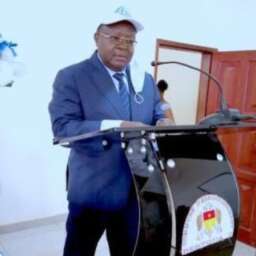












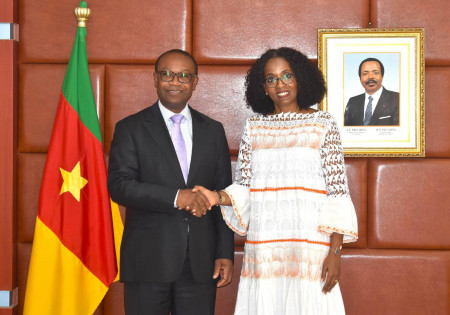
Cameroon has moved to strengthen the socio-economic inclusion of refugees by deepening cooperation between the Ministry of Small and Medium-Sized Enterprises, Social Economy and Handicrafts (MINPMEESA) and the United Nations High Commissioner for Refugees (UNHCR). The Minister, Achille Bassilekin III, has held talks with UNHCR’s Resident Representative, Yvette Muhimpundu, to reinforce joint action aimed at promoting sustainable economic inclusion for refugees and internally displaced persons, in line with national development policies and Cameroon’s international commitments.
The meeting reviewed the strategic framework guiding cooperation between Cameroon and the UNHCR under the 2022-2026 Multi-Year, Multi-Partner Strategic Plan. This framework prioritises protection, humanitarian coordination and durable solutions, with a growing focus on economic self-reliance. Discussions centred on self-employment, small and medium-sized enterprise creation, the structuring of income-generating activities and strengthening economic resilience among refugees and host communities. These priorities align directly with MINPMEESA’s mandate to promote entrepreneurship, social economy initiatives and artisanal development as drivers of inclusive growth.
The audience followed an earlier meeting held in October 2023, when both parties agreed to formalise their collaboration through a memorandum of understanding. That earlier engagement laid the groundwork for a joint programme on economic empowerment through entrepreneurship, with technical support from the Small and Medium Enterprises Promotion Agency. The planned cooperation also предусматри involvement of both institutions in promotional and capacity-building activities designed to integrate refugees into formal and semi-formal economic circuits.
While the formal cooperation framework is still being finalised, several concrete actions have already been implemented. The UNHCR participated in the 2024 International Handicrafts Exhibition of Cameroon, providing refugee artisans with a platform to showcase and market their skills. MINPMEESA, for its part, has included refugees in major national events such as the Day of Micro, Small and Medium-Sized Enterprises and the Days of Cooperation and Partnership. Joint field missions in the East and Adamaoua regions have also identified key constraints to economic empowerment, including weak business structuring, limited access to vocational training and insufficient tailored financing mechanisms.
At the local level, initiatives such as the partnership between the Bertoua Regional Artisan Village and the UNHCR Sub-Delegation have been highlighted. This collaboration facilitates refugee artisans’ access to training, production workshops and commercial spaces, supporting their gradual integration into local value chains. These initiatives position refugees not only as beneficiaries of assistance but as contributors to local economic activity.
At the close of the meeting, both parties reaffirmed their commitment to accelerating the conclusion of the memorandum of understanding and rolling out a structured joint programme for inclusive entrepreneurship. The strengthened cooperation is expected to support wealth creation, job generation and social cohesion, while reducing reliance on humanitarian aid and reinforcing Cameroon’s broader economic inclusion agenda.
Mercy Fosoh

