





























-
The CNEF expects Cameroon’s growth to slow as LNG exports decline after the Hilli Episeyo departs.
-
The oil sector is projected to contract sharply in 2026 and 2027.
-
New gas projects are under development, but none are expected to offset the loss immediately.
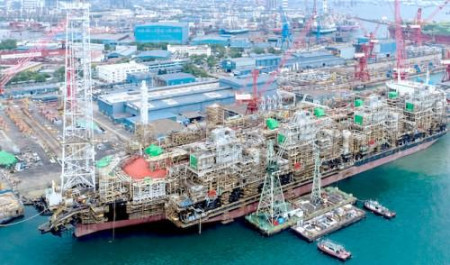
The scheduled departure of the Hilli Episeyo floating liquefied natural gas (FLNG) vessel in July 2026 is expected to weigh on Cameroon’s economy by reducing LNG exports and weakening growth, according to the National Economic and Financial Committee (CNEF).
In its first-quarter 2026 economic report, the CNEF lists the end of the vessel’s operations among the factors likely to hurt the extractive sector, exports, and the broader economy.
In the report’s detailed outlook, the committee forecasts economic growth of about 3.2% in 2026, down from 3.5% in 2025, before easing further to 3.1% in 2027. It projects the oil sector, which includes hydrocarbon extraction, to contract by 16.1% in 2026 and 18% in 2027, subtracting 0.4 percentage point from overall GDP growth in both years.
Elsewhere in the report, the CNEF presents a slightly different baseline, forecasting growth of 3.3% in 2026 and 3.2% in 2027. In both cases, it links the weaker outlook in part to the expected decline in extractive activity following the Hilli Episeyo’s departure.
LNG exports expected to fall sharply
The contract between Cameroon’s National Hydrocarbons Corporation (SNH) and Golar, which owns the floating liquefaction unit, expires in July 2026. The Hilli Episeyo has operated off the coast of Kribi since 2018, processing natural gas from the Sanaga South and Ebomé fields, among others. “With the departure of the Hilli Episeyo FLNG vessel, LNG exports are expected to decline significantly,” the CNEF said.
The report does not estimate how much of the projected slowdown will result directly from the vessel’s exit. Instead, it describes the departure as an additional risk in an environment already affected by geopolitical tensions, weaker global trade, higher energy costs, and slower performance across several export industries.
The ultimate impact will depend on production levels maintained until the contract expires, the actual timing of the vessel’s departure, and the ability of other sectors to offset the expected decline in gas activity.
LNG exports have been weakening since 2022
The Hilli Episeyo is leaving as Cameroon’s LNG export earnings are already on a downward trend. According to the National Institute of Statistics, LNG exports totaled CFA350.2 billion in 2025, down from CFA381 billion in 2024, CFA421 billion in 2023, and a peak of CFA622 billion in 2022. Export revenue fell 8.1% year over year in 2025.
Despite the decline, LNG still accounted for 11.4% of Cameroon’s total export earnings in 2025, making the vessel a key source of foreign exchange. The trend continued into 2026. During the first quarter, Cameroon’s total exports fell 23.6% to CFA606.9 billion. LNG exports dropped 28.4%, while crude oil exports declined 14.4%.
The impact of the Hilli Episeyo’s departure could be compounded by weaker exports in other sectors. During the same period, exports of cocoa and cocoa products fell 37.7%, wood and wood products 11.5%, aluminum and aluminum products 53.7%, and raw rubber 16.7%.
External accounts expected to come under pressure
Lower LNG exports could reduce Cameroon’s foreign exchange earnings and widen its current account deficit. The CNEF projects the current account deficit at 5.4% of GDP in 2026 and 6.1% in 2027, compared with an estimated 3.2% in 2025. It also expects the fiscal deficit to reach 1.7% of GDP in 2026 and 2.1% in 2027.
The committee does not attribute these forecasts solely to the Hilli Episeyo’s departure. They also reflect the potential effects of slower global trade, higher shipping costs, rising hydrocarbon prices, and weaker growth in government revenue.
Higher oil prices also create a policy dilemma. Keeping domestic fuel prices unchanged could increase government spending on fuel subsidies, while raising pump prices could fuel inflation and erode household purchasing power.
Replacement projects remain years away
To prepare for the vessel’s departure, SNH says it is diversifying its oil and gas portfolio to reduce Cameroon’s reliance on a single mature asset. Its main medium-term project is the Yoyo-Yolanda cross-border gas field shared with Equatorial Guinea. According to SNH, the field contains an estimated 2.5 trillion cubic feet of gas and could require investment of nearly $4 billion.
However, the project is not expected to provide an immediate replacement. It still requires technical and commercial agreements, financing, infrastructure development, and several years before production can begin.
SNH is also moving forward with new exploration blocks in the Rio del Rey and Douala-Kribi-Campo basins. But entering production-sharing contract negotiations does not guarantee commercially viable discoveries or near-term production.
The departure of the Hilli Episeyo is not the only reason Cameroon’s economy is expected to slow. Even so, it will remove a major source of export revenue at a time when several other export sectors are already under pressure.
While SNH’s development plans could provide new sources of growth over the medium term, none are expected to offset the decline in LNG exports immediately. The longer the gap between the vessel’s departure and the start of new gas production, the greater the pressure on Cameroon’s external accounts and economic growth.
Amina Malloum

