































Cameroon’s strategy of discouraging raw log exports through higher export taxes is beginning to weigh on customs revenue, highlighting the short-term cost of the country’s push to build a stronger domestic wood-processing industry.
According to the Ministry of Finance’s 2027-2029 Medium-Term Economic and Budgetary Programming Document, export duties collected from the timber sector fell by CFA7.9 billion in 2025, a 21.3% decline from the previous year.
The drop stands in contrast to the overall performance of customs revenue, which rose by CFA96.6 billion, or 9.1%, to CFA1.153 trillion in 2025. The timber sector was therefore one of the main factors limiting the customs administration’s overall revenue growth.
The Ministry of Finance attributes the decline to the gradual increase in export duties on raw logs, part of a broader policy designed to discourage exports of unprocessed timber and promote domestic processing.
Under the 2024 Finance Law, the export duty on logs and similar products was increased to 75% of their free-on-board (FOB) value, up from 60%.
The policy has created a fiscal paradox. By making raw log exports significantly more expensive, the government has reduced their attractiveness and, with it, the taxable base on which export duties are collected. The higher tax rate has therefore failed to offset the decline in export volumes.
Log exports fall sharply
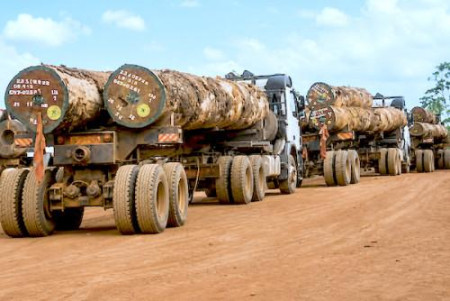
Data from the National Institute of Statistics confirm the shrinking tax base. Cameroon exported 349,611 cubic meters of logs in 2025, down from 475,401 cubic meters a year earlier, a decline of 26.5%.
The value of those exports also fell by CFA8.37 billion, dropping from CFA47.39 billion in 2024 to CFA39.02 billion in 2025, a decrease of 17.7%.
The government says the tax increase is not the only factor behind the decline. It also cites weaker activity in forestry and logging, partly because of softer international demand. The slowdown therefore reflects both tighter public policy and a less favorable external market.
The 2025 figure marks the lowest level of raw log exports in the past five years. While it confirms that the government’s strategy is reducing shipments of unprocessed timber, it does not by itself demonstrate that domestic processing has expanded enough to replace those exports.
Processed wood exports have yet to fill the gap
Exports of sawn timber—the country’s largest wood export product—also declined in 2025. Export volumes fell from 895,572 cubic meters to 762,007 cubic meters, a decrease of 14.9%.
Export revenue from sawn timber dropped by CFA22.62 billion to CFA157.67 billion, down 12.5% from CFA180.28 billion a year earlier. The revenue loss from sawn timber was nearly three times larger than the decline recorded for raw logs.
Overall, exports of wood and wood products generated CFA217.63 billion in 2025, compared with CFA249.70 billion in 2024. Export revenue from the sector therefore declined by CFA32.07 billion, or 12.8%, while export volumes fell by 26.7%. The figures suggest that lower raw log exports have not yet been matched by sufficient growth in higher-value processed products.
Some more advanced segments, however, posted gains. Exports of plywood, veneered wood, and laminated products increased by 34.1% in volume and 15.6% in value. Veneer sheet exports also rose 5.3% in volume, although their value slipped 1.3%.
The industry’s transition therefore remains uneven. More highly processed products are expanding in some segments, but they still account for too small a share of exports to offset declines in logs and sawn timber.
The real test comes in 2028
The government plans to continue its industrial strategy ahead of the regional ban on raw log exports scheduled to take effect on January 1, 2028.
To prepare for that deadline, authorities intend to encourage logging companies to invest in third-stage wood-processing equipment while giving greater preference to locally manufactured furniture in public procurement. The objective is to shift more value creation toward advanced sawmilling, veneer production, plywood manufacturing, carpentry, and furniture production.
The strategy is also intended to retain more industrial investment and jobs within Cameroon while positioning local manufacturers to benefit from new market opportunities, particularly under the African Continental Free Trade Area (AfCFTA).
The 2025 figures, however, show that the transition carries a short-term economic cost. Customs revenue has fallen, raw log exports have declined, and sawn timber exports have weakened at the same time.
For now, the higher tax has achieved one objective by discouraging exports of unprocessed logs. Whether it ultimately succeeds in creating greater domestic value remains uncertain.
The policy’s success will ultimately be measured by other indicators, including the volume of timber processed in Cameroon, new industrial investment, jobs created, domestic sales, and additional tax revenue generated by wood-processing companies. At this stage, the decline in raw log exports is clear. The expected gains in value addition have yet to be demonstrated.
BRM

