


















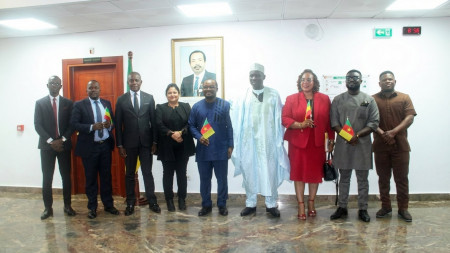
Ghanaian conglomerate Jospong Group of Companies has stepped up its economic courtship of Cameroon, signalling interest in investments that place waste management and circular economy solutions at the centre of future growth and job creation. The signal was sent during an audience granted on December 17, 2025, in Yaounde by the Minister of Economy, Planning and Regional Development (MINEPAT), Alamine Ousmane Mey, to a delegation of the Jospong Group. The delegation was led by Yvonne Belema, President of the non-governmental organisation Association Camerounaise d’Aide à l’Hygiène et à l’Insertion des Jeunes dans les Communautés (ACAHIJEC).
The meeting followed earlier exchanges between Cameroonian authorities and the Ghana-based group on the sidelines of the 9th Tokyo International Conference on African Development (TICAD 9), held in Yokohama, Japan, from August 20 to 22, 2025. Those discussions laid the groundwork for more detailed talks on potential economic cooperation and investment opportunities in Cameroon.
At the core of the discussions was waste management, an area increasingly viewed as an economic lever rather than a public service burden. Talks focused on Cameroon’s ambitions to scale up its circular economy framework, with particular attention on household and medical waste recovery and transformation. The Jospong delegation expressed interest in supporting national efforts to modernise waste valorisation systems, drawing on more than three decades of operational experience in Ghana.
The engagement highlights a growing role for the private sector in Cameroon’s environmental economy, where waste treatment is positioned as a source of industrial value chains, local production inputs and employment opportunities. The approach aligns waste management with broader economic planning objectives, including urban resilience, public health and sustainable industrialisation.
Beyond waste, the Jospong Group’s mission reflects a wider investment outlook. Founded in 1995 by Ghanaian entrepreneur Joseph Siaw Agyepong, the conglomerate operates across more than fourteen sectors, including information and communication technologies, automotive services, banking and insurance, real estate, construction, logistics, agriculture and agro-processing.
With over sixty subsidiaries, the group has developed integrated business models that link infrastructure, services and manufacturing. In Cameroon, the interest expressed in waste-to-resource initiatives is seen as a potential entry point for diversified investments, where environmental services intersect with economic transformation and long-term private-sector-led growth.
Mercy Fosoh

