























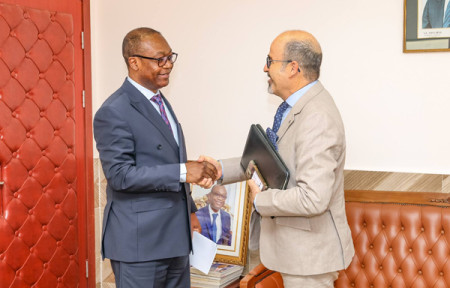
Cooperation between Cameroon and the European Investment Bank (EIB) moved into a new phase on Wednesday 25 February 2026 in Yaounde, as the Minister of Small and Medium-Sized Enterprises, Social Economy and Handicrafts, Achille Bassilekin III, received Ramon YNARAJA, the newly appointed Head of the EIB Regional Representation for Central Africa. The meeting focused on strengthening financial and technical support for small and medium-sized enterprises (SMEs), artisans and the social economy, with an emphasis on expanding access to credit and reinforcing existing funding mechanisms.
Speaking to reporters in Yaounde, Ramon YNARAJA explained that his visit formed part of a courtesy tour to ministers whose portfolios intersect with EIB operations.
“The domain of small and medium-sized enterprises is of enormous interest to the EIB, the bank of the European Union, and to the European Union itself,” he said. He added that discussions with the minister centered on how to continue existing activities in Cameroon while seeking ways “to do more and do better.”
YNARAJA stated that the BEI first listens to national authorities to understand country needs, then consults the private sector to assess demand for support, and finally works with eligible intermediaries capable of partnering with the bank. “We need all the actors in place to put together the different instruments the EIB uses to support SMEs,” he said.
He explained that the bank primarily operates through credit lines granted to eligible public or private financial intermediaries, which then convert BEI funds into loans for small and medium-sized investment projects. He noted that this work is carried out under the guidance and support of Cameroonian authorities, who indicate specific national priorities.
Strategic projects and reform proposals
Beyond credit lines, discussions also covered support for agricultural value chains, a proposed Global Innovation Centre project, financial inclusion, the digitalisation of artisan villages and the structuring of artisan clusters.
Within the framework of Cameroon’s National Development Strategy, NDS30, the ministry proposed the creation of a dedicated credit line for the BCPME, more flexible access conditions to financing, strengthened technical assistance, and the establishment of a joint MINPMEESA-EIB monitoring mechanism.
According to the ministry, the objective is to build a more inclusive, competitive entrepreneurial fabric capable of generating sustainable employment. The reinforced cooperation aims to align European financing tools with Cameroon’s development priorities, particularly in sectors with high job-creation potential and strong value chains.
MINPMEESA revealed that since 2020, a €40 million envelope has been mobilised through partner financial institutions including Société Générale Cameroun, Commercial Bank of Cameroon (CBC), PROPME and CCA Bank. According to the ministry, these funds have improved access to credit for numerous SMEs, particularly in productive sectors.
Mercy Fosoh

