


















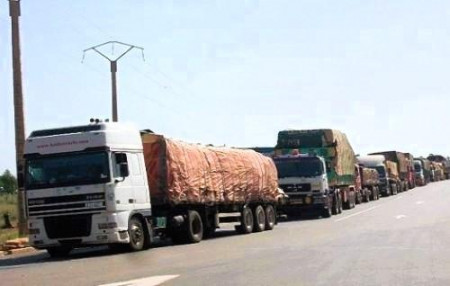
Stakeholders in the Regional Project to Improve Performance of the Douala–N’Djamena Corridor (PCDN) met on December 18, 2025, in Yaoundé for the first session of the National Steering Committee (COPIL). Chaired by Cameroon’s minister of Transport, the meeting marked a key step in the governance of a project designed to strengthen logistics performance and secure cross-border trade between Cameroon and Chad.
As the project’s strategic oversight body, the COPIL is responsible for supervising, guiding, and assessing implementation at the national level. During this inaugural session, members reviewed activity reports covering June 2024 to December 2025, validated strategic orientations for 2026, and examined the annual work plan and budget, along with internal control instruments.
A strategic but underperforming corridor
Addressing the meeting, the minister of Transport underscored the strategic importance of the Douala–N’Djamena corridor, one of the few fully operational intermodal corridors in Central Africa. He described it as the safest and most viable transit route for Chad to access maritime trade routes, highlighting its central role in economic activity and its concentration of about 35% of the combined GDP and population of the two countries.
He cautioned, however, that the corridor’s potential remains constrained by aging rail and road infrastructure, as well as cumbersome administrative procedures that slow trade flows and limit expected competitiveness gains for economic operators.
CFA11.12 billion for the rail component in 2026
To address these constraints, the 2026 annual work plan earmarks CFA11.12 billion, representing about 6.2% of the project’s total budget. Under the rail component, the funds will finance the acquisition of equipment for the rehabilitation of 238 kilometers of the Douala–Yaoundé railway line.
They will also cover consultancy services for project management of strategic supplies, including 54-kg rails, switches, and expansion devices, as well as technical assistance for works supervision. The objective is to strengthen the reliability of the rail segment, a structural link in the multimodal corridor.
Transit facilitation and administrative modernization
The project’s facilitation component also includes priority actions. These involve rehabilitating the Ngaoundéré rail-road platform, a key transshipment hub for flows between Cameroon and Chad, and procuring road safety equipment, including speed control radars and related vehicles.
At the same time, measures are planned to ease transit and trade, notably through the modernization of customs and transport administrations. The aim is to significantly improve the performance of the logistics chain along the entire corridor. Combined, these investments are expected to reduce delays, improve safety, and enhance the reliability of transit operations.
A CFA180 billion regional program through 2032
Financed by the World Bank through the International Development Association, with funding equivalent to about CFA181.0 billion (€275.9 million), the PCDN is being implemented over the 2024–2032 period. It seeks to sustainably improve the efficiency and security of cross-border trade and transit along the Douala–N’Djamena multimodal corridor.
Structured around five components, the project covers rehabilitation of Cameroon’s rail network, including the Douala–Yaoundé line and rail signaling modernization; investments in rail-road connections, rail capacity building, and road safety in Cameroon; road reconstruction and maintenance in Chad, including an emergency response component; trade facilitation and project implementation support; and a contingent emergency response mechanism.
The PCDN is expected to help cut transit times and costs, increase freight volumes, and strengthen regional cooperation, reinforcing the Douala–N’Djamena corridor’s role as a backbone of subregional trade.
Amina Malloum

