























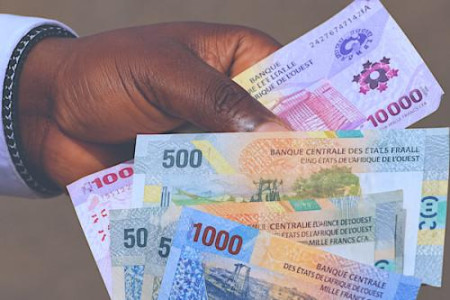
Cash in circulation continued to grow across Central Africa’s monetary union in 2025, underscoring the region’s persistent reliance on physical currency despite gradual digitalization efforts.
According to data from the Bank of Central African States (BEAC), the total value of banknotes and coins in circulation across the six CEMAC countries reached CFA5,755 billion as of December 31, 2025, up from CFA5,363 billion a year earlier. That represents an increase of about 7.3%.
In absolute terms, nearly CFA392 billion in additional cash entered circulation across the region over the year. Currency in circulation refers to the face value of money actively used in the economy, calculated as the difference between total issued currency and the amounts held in central bank vaults.
A breakdown by country shows a sharp concentration in Cameroon. With CFA2,554 billion in circulation, the country alone accounts for about 44% of the regional total. This reflects its position as the largest economy in CEMAC, as well as the heavy use of cash in trade, services, and informal activity. Chad ranks second with CFA1,174 billion, followed by Congo (CFA645 billion), Gabon (CFA614 billion), Equatorial Guinea (CFA424 billion), and the Central African Republic (CFA343 billion).
The rise in cash use may point to stronger economic activity and higher consumption. At the same time, it highlights the region’s continued dependence on cash, as electronic payment systems remain unevenly adopted across countries, sectors, and income groups.
This trend raises a dual challenge for policymakers: how to support the shift toward digital payments without disrupting economies that still rely heavily on cash, and how to improve transaction traceability in a region where much of the activity remains informal. The increase in currency in circulation reflects a broader paradox: digital tools are expanding, but cash continues to underpin daily economic life.
Amina Malloum

