





















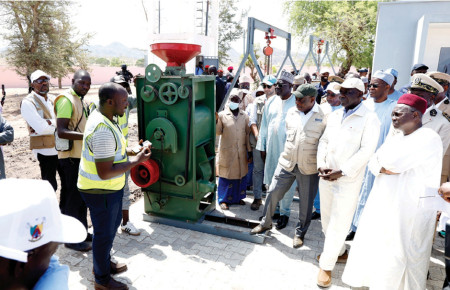
A government inspection mission to Lagdo on May 4 found Cameroon’s Benoué Valley agricultural investment was about 50% complete, with early results already visible in improved rice quality, expanding irrigation infrastructure and rising farmer incomes.
The mission, led by Minister of Economy, Planning and Regional Development Alamine Ousmane Mey, assessed progress under the Viva-Benoué project, a 117-billion-CFA-franc programme backed by the World Bank. The initiative aims to reduce Cameroon’s food import bill, which exceeds 1,000 billion CFA francs annually, including around 300 billion francs spent on rice imports alone, according to government data.
The delegation first visited the Technological Innovation Centre (CIT), the project’s agricultural research and training arm responsible for experimentation, farmer training and technical support. Around 40 women have already been trained in quality rice production techniques.
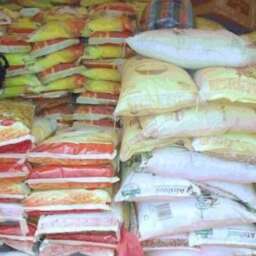
One beneficiary, Kodji Rabahou, said the training had significantly improved both rice quality and household income.
“Before, we would crush it and it would crumble. Now, when we go to the mill, nothing breaks. We also produce more quickly. All of this process has changed our living conditions. We sell the bags at 15,000, 20,000 and 25,000 francs, depending on the number of kilos,” she said.
On infrastructure, the mission confirmed the construction of a dead-head canal, the commissioning of a pipe manufacturing plant, 15 km of completed embankments, the levelling of about 1,300 hectares on the left bank and the rehabilitation of roughly 500 hectares on the right bank.
The delegation also inspected the east collar of the main irrigation canal, from where water from the Lagdo dam will be distributed to agricultural fields. Once operational, the irrigation system is expected to allow at least two cultivation cycles and two harvests per year, effectively doubling productive capacity on irrigated land.
Youth workers were also active on several construction sites linked to the irrigation works.
Minister Mey said the project was part of the government’s broader strategy to strengthen food security and reduce dependence on imported staple foods.
“117 billion francs have been mobilised from the World Bank to this end. We intend to directly impact more than 26,000 people and indirectly 100,000 inhabitants in this locality in the prospect of mastering water management, raising the quality and quantity of rice production, improving commercialisation, and engaging an integrated development process in this part of our country,” he said.
Beneficiaries’ spokesman Ndjabo Falama said farmers were committed to sustaining the project’s gains, adding that the equipment and inputs distributed would help increase yields, revenues and food security.
“We express our profound gratitude to the government through the Minepat, as well as to the project and all its partners for this precious support,” he said.
The minister also noted that the strong participation of women in the project was aligned with presidential directives placing women and youth at the centre of the country’s current seven-year development agenda.
Mercy Fosoh

