





















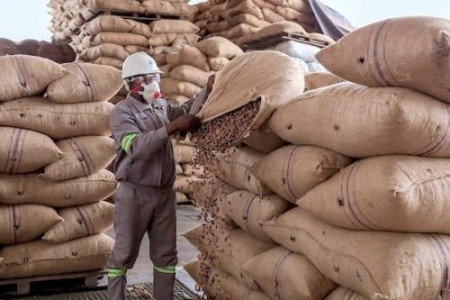
- Cameroon’s marketed cocoa production fell 19.9% year-on-year to 247,914 metric tons during the 2025-2026 season, reversing the record harvest achieved a year earlier.
- The 2025-2026 campaign recorded the lowest marketed cocoa volume in five seasons, as climate change, aging plantations and declining soil fertility continued to weigh on production.
- The Centre Region remained the country’s largest cocoa marketing hub, accounting for 44.54% of officially recorded purchases during the season.
Cameroon recorded 247,914 metric tons of marketed cocoa production during the 2025-2026 marketing season, according to data from the National Cocoa and Coffee Board (ONCC) reviewed by Business in Cameroun.
The volume declined by 61,604 metric tons, or 19.9%, from 309,518 metric tons recorded during the 2024-2025 season.
The decline followed an exceptional 2024-2025 campaign, when Cameroon achieved its highest marketed cocoa production on record. During that season, the ONCC also reported farm-gate prices ranging between CFA3,210 and CFA5,400 per kilogram.
Marketed production reflects only the volumes traded through official marketing channels. Consequently, the figure does not necessarily represent total cocoa harvested because it excludes inventories and production that bypasses formal commercial networks.
Lowest Volume in Five Seasons
The 2025-2026 cocoa season officially ran from August 1, 2025, to July 15, 2026.
With 247,914 metric tons marketed, the campaign delivered the weakest result of the past five seasons.
Before the record 2024-2025 harvest, Cameroon marketed 295,164 metric tons during the 2021-2022 season. The ONCC subsequently reported 262,112 metric tons in 2022-2023 and 266,710 metric tons in 2023-2024.
The decline erased the gains achieved during the previous campaign.
The ONCC data did not specify the immediate causes of the contraction. However, Cameroon’s cocoa industry continues to face several structural constraints.
Industry stakeholders cited climate change, characterized by irregular rainfall, prolonged droughts and increasing pest pressure, as the main challenges. They also pointed to declining soil fertility and the aging of cocoa plantations.
Persistent Climate and Agronomic Challenges
Industry experts said climate change has disrupted cocoa tree flowering, reduced pod development and limited the availability of planting material needed to establish new plantations or rehabilitate aging orchards.
On that front, the Cocoa Development Corporation (Sodecao) said it loses 40% to 50% of young cocoa seedlings each year in some of its nurseries.
Those losses have constrained efforts to renew aging plantations at a time when the industry seeks to raise productivity without accelerating agricultural expansion into forest areas.
Centre Region Accounts for 44.54% of Purchases
Despite the nationwide decline in marketed production, the Centre Region remained Cameroon’s largest cocoa marketing hub.
The region accounted for 44.54% of officially recorded cocoa purchases during the 2025-2026 season, compared with 45.8% in 2024-2025. Based on total marketed production, that share represented approximately 110,421 metric tons of cocoa beans.
The Southwest Region ranked second with 19.87% of purchases, equivalent to about 49,261 metric tons, followed by the Littoral Region, which accounted for 18.50%, or approximately 45,864 metric tons.
The South and East regions represented 6.54% and 6.17% of purchases, respectively. Meanwhile, the West Region accounted for 4.14%, while the Northwest and Adamawa regions contributed only 0.19% and 0.06%, respectively.
This article was initially published in French by Brice R. Mbodiam
Adapted in English by Ange J. A de Berry Quenum

