































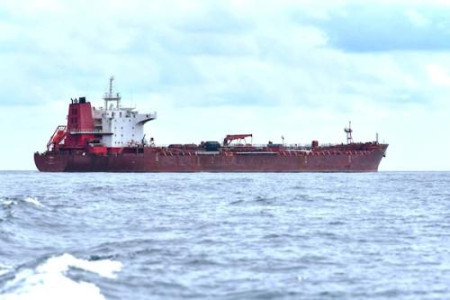
Cameroon has faced mounting pressure from several European partners for months after dozens of oil tankers linked to Russia’s maritime registry were registered under its flag. According to data from the Ministry of Transport reviewed by Business in Cameroon, 37 such vessels obtained Cameroonian registration, raising questions about how rigorously oversight is enforced by the national maritime administration.
A Concentrated Surge Across Three Ports
Registrations became increasingly concentrated from late 2025. The data shows a peak in January and February 2026, following a sharp rise already visible in November and December 2025. That acceleration has led several European observers to conclude that the Cameroonian registry may have been used by vessels displaying characteristics associated with networks designed to circumvent sanctions targeting Russian hydrocarbon exports.
The registrations are spread across three maritime jurisdictions. Kribi leads with 15 vessels, followed by Limbe with 13 and Douala with nine. That distribution gives the phenomenon a national dimension while showing that it moved through clearly identifiable administrative channels.
The dataset breaks down three categories of tankers: crude oil carriers, refined product carriers and multipurpose vessels. Within that group, vessels linked to the Russian registry account for 27.8% of the total. More strikingly, they represent, according to the source document, 67.6% of crude oil carriers registered under the Cameroonian flag in the same dataset.
These proportions, unusual for a single foreign registry source, make the issue more than a statistical anomaly. They raise a broader question: what role African maritime registries can play in an international environment increasingly defined by compliance, traceability and control of energy flows.
Vessels With a Sensitive Profile
The document notes that a majority of the tankers had previously sailed under flags of countries often cited in international maritime debates for the flexibility of their registration procedures. Twenty-four of the 37 vessels linked to the Russian registry had previously flown the flags of Gambia, Palau, the Comoros, Mozambique, Benin, the Maldives, Mali or Sierra Leone before switching to the Cameroonian flag.
There is also opacity surrounding certain operators. Of the 37 vessels, 35 different operators are recorded, meaning nearly one operator per ship. In international shipping, that degree of fragmentation can be a red flag, particularly when combined with entities that are difficult to identify or trace. The document cites several generic company names, as well as one vessel, the GENJI, registered under the notation “Rptd Sold Undisclosed Interest,” indicating an owner that has not been clearly identified.
Individually, none of these elements constitutes definitive proof. Taken together, however, they form a body of circumstantial evidence dense enough to explain the growing unease among European partners over the evolution of the Cameroonian registry.
European Pressure Mounts
Several European countries formally approached the Cameroonian government in February over these registrations, according to the document. The context is clear: since Russia’s invasion of Ukraine, the European Union has sought to reduce Moscow’s energy revenues by targeting the commercial channels through which Russian oil is traded. In that strategy, flags issued by third countries have become a major focus of scrutiny.
According to the document, Brussels is applying pressure for a cleanup of the Cameroonian registry and is considering tying certain financing arrangements to reforms of flag attribution procedures. For Cameroon, the stakes go well beyond administrative technicalities. They affect the country’s credibility in its compliance commitments, its relationships with donors and, more broadly, its reputation as a reliable maritime jurisdiction.
In a sector where regulatory standing carries as much weight as port infrastructure, a registry perceived as insufficiently rigorous can quickly become an economic and diplomatic liability.
Yaounde Cites Limited Means
In response to the criticism, Cameroonian authorities have pointed to operational constraints. They say they lack the resources to verify the background of shipowners seeking the national flag and to effectively monitor vessels at sea once registration has been granted. They also say a modernization text for the maritime sector is being prepared, with the stated aim of making flag attribution more transparent and more rigorous.
That response raises a central question: in a globalized maritime environment where risks of sanctions evasion, concealed ownership and rerouted voyages are increasing, can a state continue to expand its registry without verification capabilities that match those risks?
The dilemma for Yaounde is real. Expanding its registry increases its weight in the maritime economy. But doing so without adequate safeguards risks turning it into a weak link in a compliance chain now under global scrutiny.
Ultimately, the issue goes beyond the 37 vessels identified in the data. It places Cameroon before a strategic choice: to make its maritime registry a credible instrument of economic sovereignty backed by robust controls, or risk it being seen abroad as a convenient gateway for the kind of trafficking that other jurisdictions are working to shut down.
Ludovic Amara

