



















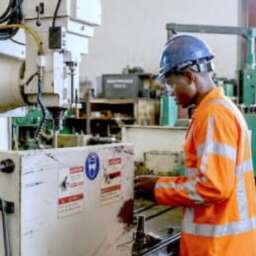








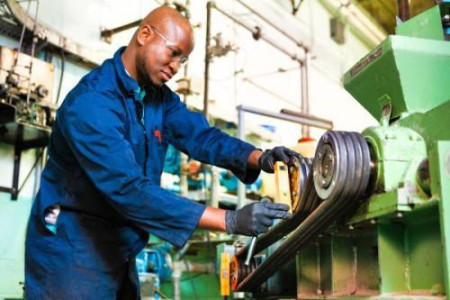
Mechanical and electrical machinery accounted for 14.5% of Cameroon’s total import spending in 2025, valued at 757.4 billion CFA francs, according to foreign trade data from the National Institute of Statistics (INS). The institute said such equipment “plays a crucial role in the country’s economic development.”
Despite this significant share, the value of these imports fell 3.7% from 2024, pointing to a slight slowdown after several years of strong demand for production equipment. They nonetheless remain an indicator of investment in the country’s industrial base, driven in recent years by the installation of new industrial units and capacity expansion across several sectors.
China becomes leading supplier
Beyond volumes, data show a gradual shift in Cameroon’s sources of industrial machinery and equipment.
In its 2024 report on the competitiveness of the Cameroonian economy, the Competitiveness Committee under the Ministry of the Economy noted a sharp increase in China’s market share in this segment. China’s share rose from 23.8% in 2016 to 52.5% in 2024, a gain of 28.7 percentage points, making it Cameroon’s top supplier of industrial equipment.
By contrast, the European Union’s share declined from 50.1% to 32.3% over the same period, despite a slight recovery after 2023.
This shift comes as the Economic Partnership Agreements (EPAs) between Cameroon and the European Union, in force since 2016, provide for the gradual removal of customs duties on 80% of EU imports over 15 years.
Industrial machinery and equipment are among the products subject to these tariff cuts. Yet European suppliers have continued to lose ground to Asian competitors, particularly China.
Rising demand, persistent structural constraints
The high level of industrial equipment imports reflects Cameroon’s ongoing need for production infrastructure and highlights evolving supply chains amid intensifying competition among trading partners.
However, rising imports have not translated into improved production capacity. In its report on the economic and financial situation of enterprises in 2023, the INS said the condition of production equipment continued to deteriorate. The share of machinery in poor condition rose from 59.6% in 2022 to 60.1% in 2023.
In practical terms, six out of every 10 machines in Cameroonian firms were operating in poor condition. Maintenance challenges were cited among the main causes, with direct effects on productivity, including lower revenues, supply constraints, market shortages and temporary layoffs.
Overall, strong demand for industrial equipment underscores Cameroon’s need to modernize its economy. It also points to a more complex reality: higher imports alone are not enough to ensure lasting gains in productivity, as long as issues related to maintenance, equipment renewal and quality remain unresolved.
Amina Malloum

