






















Cameroon’s Economic Policy Management Program (GPE) wants to regain its regional standing after years of decline by focusing on digital training, data skills and modernization.
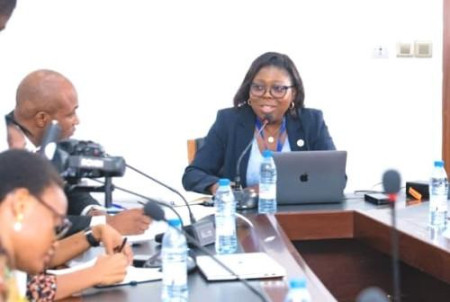
The institution, hosted at the University of Yaoundé II, presented its new strategy on May 6 during a press conference in Yaoundé. The plan is part of the program’s 2025–2029 roadmap and aims to adapt training to the changing needs of public administrations across Central Africa.
Created in 1999 with support from the World Bank and the African Capacity Building Foundation, the GPE was originally designed to train specialists in economic policy for French-speaking sub-Saharan Africa.
The program now covers 12 countries, including all six CEMAC member states as well as several countries in the Great Lakes region.
But the institution lost momentum after its main international donors withdrew. According to the program’s press file, external funding ended in 2017, leaving the Cameroonian government to fully finance the institution from 2018 onward.
That transition coincided with a slowdown between 2018 and 2021.
To rebuild its appeal, the GPE now plans a broad digital transformation. The program announced the creation of a digital campus, the digitization of academic and administrative procedures, and the launch of an interactive platform for course management, student monitoring and access to educational resources.
The institution also plans to expand hybrid learning programs that combine in-person classes with online instruction.
The modernization effort includes infrastructure upgrades as well. Officials announced plans to open connected learning spaces, a digital media library and a fully integrated digital learning environment.
A New Focus on Data
The GPE also plans to reshape its academic offerings. A central part of the strategy is a master’s program in Data, Economics and Development Policy, which officials describe as one of the institution’s main repositioning tools.
The goal is to train professionals who can use data to design, monitor and evaluate public policies. The institution also plans to introduce five specialized certificate programs.
Beyond Cameroon, the GPE wants to strengthen its regional partnerships. Officials announced plans for a cooperation agreement with Gabon’s IEF as part of a broader effort to rebuild academic and institutional ties across Central Africa.
The institution also wants to strengthen its alumni and partner networks to expand its visibility across the CEMAC zone and the Great Lakes region.
The strategy comes as governments across the region increase their use of digital systems and data analysis in economic management and public policy.
GPE officials also expect demand for policy and data expertise to rise as several CEMAC countries continue or prepare discussions with the International Monetary Fund.
“At this crucial moment, when all CEMAC countries are entering agreements with the International Monetary Fund, the GPE has an opportunity to provide the skills needed to carry out these reforms,” the program said.
The transformation effort is being led by Professor Viviane Ondoua Biwolé, who took over the institution in 2024.
The GPE plans to highlight its new direction during a graduation ceremony scheduled for May 22, 2026, at the Hilton Hotel in Yaoundé. The event will honor the 22nd graduating class of the master’s program in economic policy management and the second graduating class of the data master’s program.
Organizers say the ceremony will bring together government officials, technical and financial partners, diplomats and private-sector representatives.
The challenge now will be whether the institution’s digital overhaul can restore its place as a leading regional center for economic policy training in a more competitive environment increasingly shaped by data and technology.
Amina Malloum

