






























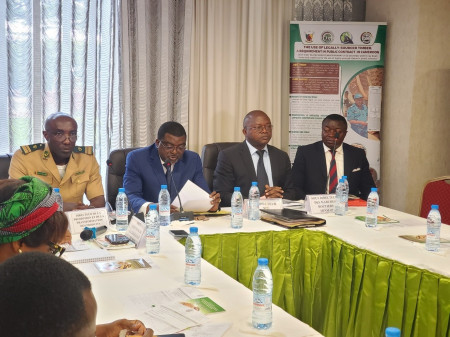
Cameroon has renewed efforts to force the use of legally sourced timber in public contracts, as officials seek to curb tax losses, tackle illegal logging and tighten control over a public sector market consuming about 13,000 cubic meters of wood each year. The latest move came at a recent workshop in Yaounde where heads of procurement units from ministries and public administrations were briefed on enforcement of a 2020 joint ministerial order governing timber used in state contracts.
The meeting, organized by the Ministry of Forestry and Wildlife (MINFOF), was chaired by Technical Adviser No.1 Landry Ngono Tsimi on behalf of Forestry Minister Jules Doret Ndongo. It focused on Joint Order No. 0162/MINFOF/MINTP/MINMAP of 15 December 2020, signed by the ministries of forestry, public works and public contracts, which sets the rules for the use of legal wood in public procurement.
The financial stakes are considerable. Director of Promotion and Transformation of Forestry Products at MINFOF, Dr Tadoum Martin, laid out the scale of the problem in stark terms.
“The public sector consumes approximately 13,000 cubic meters of wood per year. The supply used is of dubious origin, which means there is not only a loss of tax revenues for the state, but also an impact on the forest in terms of deforestation and degradation,” Dr Tadoum said.
He added that the joint order was therefore a significant government measure designed to ensure that all wood used in the execution of public contracts comes from legal, traceable sources.
The 13,000-cubic-metre figure, drawn from data compiled by MINFOF and the Centre for International Forestry Research (CIFOR), represents wood consumed annually through public infrastructure and construction contracts. Officials acknowledge that a substantial portion of this supply is currently sourced outside formal, taxed channels, depriving the treasury of fiscal receipts that would otherwise accrue from legally documented timber transactions.
Compliance gap
Technical Adviser No. 1 at MINFOF, Ngono Tsimi Landry, who presided over the workshop on behalf of Forestry Minister Jules Doret Ndongo, acknowledged that despite the order having been in force since December 2020, implementation across the public sector has remained inconsistent.
The workshop was the latest in a national rollout of sensitization events that began with a national launch in Yaounde on 10 September 2025, followed by a series of regional workshops held between October 2025 and January 2026.
“This is the continuation of a process aimed at combating illegal logging and promoting the domestic market for wood from legal sources. The use of legally sourced wood in public procurement sends a clear signal of the state’s determination to maximize tax revenues and consolidate the forestry sector as one of the levers of economic growth,” Ngono Tsimi said.
He outlined a range of measures already deployed to support compliance, including the operationalization of SIGIF2, the second-generation Forestry Information Management System designed to track the legality and traceability of timber as well as the expansion of the Domestic Timber Market through new sites across the country. He urged all participants to ensure that legal timber in public contracts becomes an operational reality rather than a policy aspiration.
Compliance hindered by lack of awareness
A Research Officer from the Ministry of Public Contracts, Doh Ferdinand, highlighted a further dimension to the compliance problem: many officials responsible for awarding contracts were simply unaware that the joint order existed.
“Ignorance of the law is not an excuse. We are here to sensitize and inform the chiefs of services in ministries concerning the award of contracts, so that they take care to use legal wood in the execution of those contracts. The Cameroon government has signed many international conventions and has been working hard to manage its forests,” Doh stated.
He made clear that the workshop represented the beginning, not the conclusion, of an enforcement drive. Officials intend to move beyond awareness-raising to ensure the order is actively implemented across all ministries.
Cameroon’s forestry sector is the second-largest contributor to foreign exchange earnings after oil, making the sustainable management of its timber resources a key economic priority. Controlling the origin of wood in public procurement, officials argue, would not only protect the forest estate from illegal exploitation but would also channel timber transactions through formal, taxable systems with direct benefits for public finances.
Mercy Fosoh

