





























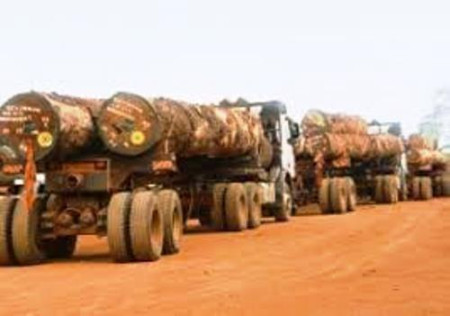
Cameroon has tightened restrictions on raw timber exports as the government continues efforts to build a larger domestic wood-processing industry. In a decree signed April 28, Forests and Wildlife Minister Jules Doret Ndongo updated the list of tree species authorized for export in log form.
The number of species banned from log exports now rises from 76 to 91. Another 23 species remain eligible for export under a special “promotion species” regime, subject to additional taxes on unprocessed forest products.
The system divides those exportable species into two categories: 14 first-category species and 9 second-category species. Azobé, also known as Bongossi, now falls under a separate quota system managed directly by the ministry.
The decision follows a broader regional policy shift. In February 2024, Central African Economic and Monetary Community (CEMAC) countries and the Democratic Republic of Congo agreed on a gradual phaseout of log exports, with a full ban scheduled for January 1, 2028.
CEMAC countries officially began the transition in January 2025. For Cameroon, the latest decree marks another step in a policy already underway rather than a sudden change. The government’s objective is clear: reduce exports of raw timber and increase exports of processed wood products. The strategy reflects both industrial and commercial goals.
Over the past several years, Cameroon has steadily increased taxes on log exports to make raw timber shipments less attractive. Between 2017 and 2024, export duties on logs rose from 17.5% to 75% of FOB value.
At the same time, authorities introduced incentives to support local wood processing, including tax exemptions on certain industrial equipment and the allocation of 224 hectares of industrial zones in the East region.
The broader goal is to shift the sector away from raw commodity exports toward higher value-added production.
Processed products such as sawn wood, veneer, plywood, and furniture generate more revenue, jobs, and industrial activity than unprocessed logs. Authorities also hope the policy will strengthen local investment, tax collection, and industrial employment.
Early signs of that shift already appear in trade data. According to figures compiled from the National Institute of Statistics’ 2025 report, Cameroon’s log exports fell to 349,611 tons in 2025, down by more than 100,000 tons year over year.
The 2025 level marks the lowest volume recorded in the past five years after exports ranged between about 475,401 tons and 958,300 tons between 2021 and 2024. At the same time, sawn wood continues to dominate the country’s wood exports, suggesting that first-stage processing is gaining importance.
Still, the transition carries risks. Restricting raw timber exports can encourage local industrial investment, but only if companies have the technical, financial, logistical, and energy capacity to process larger volumes domestically.
The policy also requires stronger enforcement. A tighter ban could increase illegal trade if monitoring and traceability systems fail to keep pace. For the government, the challenge is no longer simply banning log exports. The bigger test is whether the country can build a profitable and credible industrial alternative before the 2028 deadline arrives.
Frédéric Nonos

