






















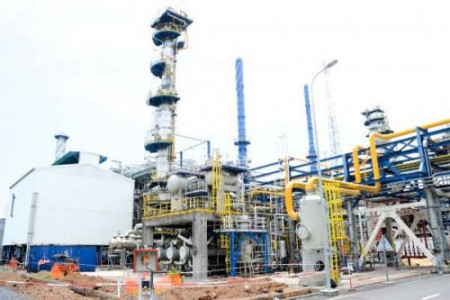
(Business in Cameroon) – Six years after a fire shut down the country’s only refinery, the Cameroonian government has set a roadmap to restart the National Refining Company (Sonara), with the goal of doubling capacity from 3.5 to 7 million tons of crude per year. Following a recommendation from the shareholders’ meeting of July 24, 2025, the board of directors adopted on August 13, 2025 an updated Restructuring and Rehabilitation/Reconstruction Action Plan, based on conclusions from French engineering firm EKIUM. The study found that a gradual rehabilitation of the Limbe site is technically and economically feasible.
The selected approach, known as “option 3,” is based on a phased restart of the refinery, linked to the “Sonara 2010” expansion project and modernization in line with recent international fuel standards. An internal note says the plan prioritizes bringing existing units back into service progressively, with capacity increases planned at a later stage. Financially, the strategy is to resume operations before launching the most capital-intensive investments, given the company’s heavy debt constraints.
Parras 24: return to 2019 operations by 2027
The first phase, scheduled from January 2026 to December 2027, is the core of the Acceleration Plan for the Restructuring and Rehabilitation of Sonara, known as Parras 24. It aims to restore the refinery to its operational configuration of May 2019. The EKIUM audit concluded that a significant share of damaged equipment can still be reused.
An internal Sonara document indicates “a minimum of 75% reusable equipment in the damaged area, 8% to be dismantled or scrapped, and 17% potentially recoverable subject to in-depth inspection, with generally acceptable preservation of equipment in non-affected areas.” This first stage includes rehabilitation of damaged units, completion of phase 1 units of the “Sonara 2010” project, and upgrades to installations that were not affected by the fire.
The use of reusable equipment has been factored into timelines and cost estimates, subject to the results of detailed inspections of the 17% classified as potentially recoverable.
Financial structuring and planned PPP
At the same time, Sonara is working with AXENS on preliminary design studies needed for the project’s financial structuring. According to the team of Sonara chief executive officer Hadj Bako Harounaes, the aim is to prepare for a public-private partnership (PPP) for later phases. Under the internal schedule, if the studies are completed in 2026 and the refinery resumes operations in 2027, the project could be submitted to the PPP Approval Committee (CARPA) to assess its eligibility.
During a meeting held in October 2025, the Bank of Central African States (BEAC) raised concerns about the proposed financing structure. According to Sonara, the BEAC requested clearer details on how funds would be mobilized. “In this context, implementation of phases 2 and 3 remains conditional on finalizing the financial architecture and assessing the project’s bankability,” the company said.
Industrial modernization: hydrocracker and second train
The second phase, planned for 2028–2030, involves completing the “Sonara 2010” project with the installation of a hydrocracker and new processing units. This phase is expected to align production with AFRI 5/6 and MARPOL standards and increase the share of higher value-added products. Under this plan, vacuum gas oil (VGO), a heavy fraction from vacuum distillation, would no longer be sold in raw form but converted into white products, changing the refinery’s output mix and margins.
The HYDRAC/CLS report states that these works can be carried out while the refinery is already operating.
The third phase, scheduled for 2031–2035, involves building a second refining train. This would raise Sonara’s capacity from 3.5 to 7 million tons of crude per year. The projected increase is intended to sustainably cover national demand through 2050 and reduce fuel imports, subject to demand trends, competition, and financing conditions over the period.
Revised cost, new competition, and heavy debt
The cost of Parras 24 is currently estimated at CFA300 billion, higher than earlier estimates made between 2020 and 2021, which ranged from CFA111 billion to CFA278 billion. The increase reflects price updates over more than five years and a broader scope of work, including rehabilitation of units 15, 255, and 225, upgrades to certain storage tanks, and the implementation of an electricity supply strategy to complete phase 1 of the “Sonara 2010” modernization project, which was underway at the time of the 2019 fire.
The restart comes as SNH Tradex and Ariana Energy plan to build, on a 250-hectare site, a refinery with a processing capacity of 30,000 barrels per day, along with a fuel storage terminal offering initial capacity of between 250,000 and 300,000 cubic meters. This project would add new potential capacity to the national refining and storage system.
Sonara also carries a heavy debt burden. It currently owes CFA261 billion to banks, a debt rescheduled over 10 years since 2021 at an interest rate of 5.5%. It also owes several oil traders: CFA185 billion to Vitol, CFA8.5 billion to PSTV, CFA14 billion to Trafigura, and CFA20 billion to Mercuria Energy.
Repayment of these liabilities has been supported since 2022 by a state mechanism that levies CFA47.8 on each liter of fuel sold at the pump. The mechanism is intended to stabilize debt servicing and remains in place pending full implementation of the restart plan and associated modernization phases.
Amina Malloum

