

















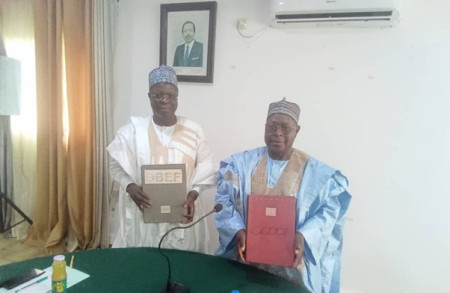
The Agricultural Research Institute for Development (IRAD) and the Yagoua Rice Expansion and Modernisation Company (SEMRY) signed a three-year partnership agreement in Yaounde , on April 24, to raise seed quality, rehabilitate farmland and increase output in the Far North.
The agreement, signed under the World Bank backed VIVA Logone project, was formalised by IRAD Director General Dr. Noé Woin and SEMRY Director General Fissou Kouma in the presence of project coordinator Laoumaye Merhoye, agriculture ministry officials, researchers and executives from both institutions. The three-year agreement tasks IRAD with deploying its scientific and technical expertise in varietal selection, variety registration, and the production of improved foundation seeds to support the seed programme of the Centre for Technological Innovation (CIT).
Under the terms of the agreement, IRAD will deliver: “a varietal selection of rice adapted to SEMRY’s irrigated perimeters and to the Far North region; support for SEMRY throughout all stages of the registration process; and guidance for SEMRY in the production of foundation seeds and R1 certified seeds, prior to any phase of multiplication or distribution.”
Speaking ahead of the signing, Kouma stated that IRAD’s scientific, technical, and technological expertise would underpin the rehabilitation of 12,350 hectares of rice perimeters in Yagoua and Maga.
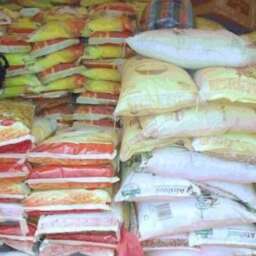
Rice remains a major import item for Cameroon, making local production gains economically significant. According to African Agribusiness, Cameroon’s rice import bill stood at 268.7 billion CFA francs in 2025. This equaled 5.1% of the country’s total import expenditure, despite a 15.6% year-on-year decline driven partly by the government’s import-substitution policy. Separate estimates put Cameroon’s annual rice import bill at approximately 242 million US dollars, a figure the government’s National Development Strategy, NDS30 explicitly targets for reduction through expanded domestic production.
Cameroon struggles to meet its national rice demand of approximately 576,949 tonnes per year, according to the National Institute of Statistics (INS). Cereals as a whole accounted for 8.9% of Cameroon’s total import spending in 2025, with rice and wheat the two dominant categories.
The IRAD-SEMRY partnership, anchored in the irrigated perimeters of the Far North region, directly targets that structural gap, bringing research capacity and certified seed production to bear on a sector whose performance has broad consequences for Cameroon’s food security balance sheet.
For businesses, the new pact signals potential opportunities across seeds, fertiliser, irrigation services, farm machinery, transport and grain processing. Improved certified seed availability can raise yields, while rehabilitated perimeters may support larger harvest volumes and more stable raw material supply for millers.
The Far North is also a strategic employment zone where stronger rice production can support farm incomes, seasonal labour demand and logistics activity. SEMRY has historically played a central role in organised rice farming in the region.
Mercy Fosoh

