





















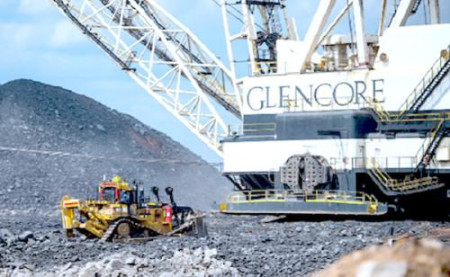
Commodity trader Glencore says it paid about $33.08 million, or nearly CFA18.5 billion, to Cameroon between 2024 and 2025 through its extractive activities linked to the Bolongo oil project.
The figures come from the company’s reports on payments to governments, published under transparency rules that apply to extractive industries in the United Kingdom. The disclosures provide a snapshot of Glencore’s financial contribution in one of Cameroon’s aging oil basins.
Most of the payments made over the two-year period were tied to production entitlements transferred to the Cameroonian state through the National Hydrocarbons Corporation (SNH), along with taxes on profits.
Out of the CFA18.5 billion paid during the period, less than CFA5 billion came from income taxes. The remainder came from production entitlements, meaning the state’s share of oil production under production-sharing contracts.
In 2025 alone, Glencore reported payments of $11.5 million, or about CFA6.5 billion, to Cameroon. That amount included $9.795 million in production entitlements and $1.705 million in income taxes. The company’s 2025 report states that the payments were tied exclusively to the Bolongo project.
A year earlier, Glencore reported significantly higher payments totaling $21.58 million, or about CFA12.1 billion. Those payments included $16.077 million in production entitlements and $5.504 million in income taxes.
The comparison points to a sharp decline in Glencore’s payments to Cameroon between the two years, affecting both production-related transfers and taxes paid to the state.
Production Decline Weighs on Payments
Operational data released by the company shows a similar trend.
In 2025, Glencore’s attributable production from the Bolongo project totaled 161,000 barrels, down from 201,000 barrels in 2024, a 20% year-over-year decline.
The drop reflects the gradual decline of a mature asset located in the Rio del Rey basin, where production has weakened across several of Cameroon’s historic oil fields.
The contrast becomes even sharper when Cameroon’s figures are compared with Glencore’s operations elsewhere in Africa.
In Equatorial Guinea, the company reported payments exceeding $214 million, or about CFA120.8 billion, in 2025 from activities linked to the Aseng and Alen blocks. According to the report, those payments included production entitlements, income taxes, and royalties.
The gap with Cameroon reflects far higher production levels as well as stronger oil and gas asset values in Equatorial Guinea, another member of the Cemac regional bloc.
Bolongo remains the only Cameroonian asset listed in Glencore’s extractive portfolio, limiting the company’s exposure to the country and highlighting the relatively small scale of its local operations compared with its regional business.
Glencore Exploration Cameroon and SNH signed the original exploration agreement for the Bolongo block in 2009, with planned investment estimated at $13 million, or about CFA7 billion, over three years.
Exploration work later identified hydrocarbons at the Oak well, which SNH at the time described as having “very strong flow rates and high-quality oil and reservoir characteristics.”
In 2018, SNH announced that Glencore had transferred 50% of its rights and obligations in the Bolongo block to Perenco, which also became operator of the asset.
At the time, the deal was presented as part of the development of the Oak field, expected to help raise Cameroon’s national oil production by around 10,000 barrels per day.
Eight years later, however, the latest figures published by Glencore point to an asset in decline, with falling output and shrinking financial contributions to the state.
Amina Malloum

