
































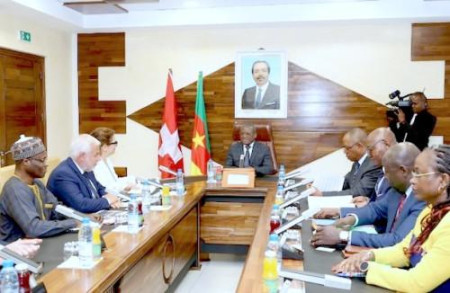
Cameroon has opened discussions with Terminal Investment Limited (TIL), the port operating company closely linked to Mediterranean Shipping Company (MSC), as it seeks to move the long-delayed Limbe deep-sea port project toward implementation.
Prime Minister Joseph Dion Ngute met a TIL delegation in Yaoundé on July 15 to discuss the project. Based in Switzerland, TIL specializes in the development, acquisition and operation of container terminals worldwide.
Through its close ties to MSC, one of the world’s largest shipping companies, TIL could bring not only technical expertise and investment capacity but also access to the group’s global maritime network.
Following the meeting, David El-Bez, TIL’s East Atlantic and Africa Director, confirmed that discussions had begun. “We came at the invitation of the Cameroonian authorities to explore opportunities for developing the Limbe deep-sea port,” he said.
No investment agreement or contract has been announced. However, the meeting marks another step in the government’s search for a strategic partner capable of delivering a project that has remained under discussion for nearly 15 years.
The Limbe deep-sea port has gone through several revival attempts without construction ever beginning. In 2019, the government commissioned an international consulting firm to update the project’s feasibility study. The process was suspended in 2020 because of the COVID-19 pandemic before resuming in 2021 and concluding the following year.
The project has recently regained momentum. On June 18, the Prime Minister convened the main ministries and public institutions involved to review implementation options based on the updated feasibility study. The meeting with TIL less than a month later suggests the government is moving beyond the planning stage toward the technical and financial structuring of the project.
Key details, however, remain unresolved. Authorities have yet to disclose the preferred partnership model, implementation timetable or the level of commitment expected from a private investor.
During the discussions, TIL offered its expertise in building and operating port terminals, along with the international operating standards used across MSC’s global network.
The value of such a partnership extends beyond infrastructure development. Through TIL’s connection to MSC, the future Limbe port could gain quicker access to major international shipping routes, an important advantage for attracting cargo volumes and improving the project’s commercial viability. After the meeting, El-Bez said TIL would continue working with the Cameroonian authorities to develop proposals for the project.
Neither TIL nor MSC is new to Cameroon. The group already operates in the country’s port sector, including activities in Douala and Kribi, and is also involved in logistics projects linked to Camrail’s rail operations. That existing presence could help TIL assess cargo flows, logistics constraints and the commercial potential of the future port. Even so, the government will still need to define how project risks, financing arrangements, operating responsibilities and any state guarantees will be allocated.
If completed, Limbe would become Cameroon’s third major commercial port after Douala and Kribi, adding to the country’s roughly 400-kilometer Atlantic coastline. Its location near Nigeria is expected to be its main strategic advantage. The port could strengthen trade with Africa’s largest economy while giving Cameroon greater access to West African markets.
It could also complement the country’s existing ports. Douala still handles most of Cameroon’s maritime traffic but continues to face draft limitations and congestion. Kribi, designed to accommodate larger vessels, is still expanding its capacity.
Authorities will therefore need to clearly define Limbe’s role—whether as a container terminal, industrial port, energy hub, multipurpose facility or a combination of these functions—to avoid duplicating investments and creating unnecessary competition among the country’s ports.
The project is expected to cost more than CFA400 billion, making a public-private partnership or a consortium of investors and lenders the most likely financing option.
The government must also identify the supporting infrastructure needed to ensure the port’s commercial success, including road and rail connections, electricity supply, logistics zones, customs facilities and secured land. Without those investments, even a modern deep-sea port could struggle to attract enough cargo to operate profitably.
The project has previously drawn interest from American and Turkish investors. TIL’s entry adds another potential partner, but no final decision has been made.
For Cameroon, the challenge is no longer attracting expressions of interest. It is selecting a partner and financing model capable of delivering, funding and operating the port. After nearly 15 years of delays, the project’s credibility will depend on how quickly the government can finalize those decisions.
Ludovic Amara

