
















The Cameroonian government is finalising a new national biodiversity strategy aimed at positioning natural ecosystems as a central pillar of the country’s economic transformation agenda under the National Development Strategy (NDS30). The third National Biodiversity Strategy and Action Plan (SPANB III) is expected to receive final validation on 22 May 2026 during the commemoration of the International Day for Biological Diversity.
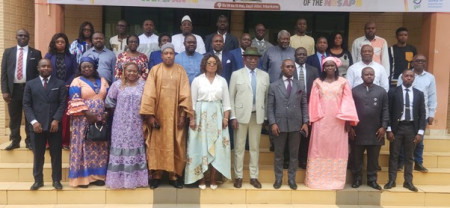
The latest phase of the process was launched on 18 May in Mbankomo, where the Secretary General of the Ministry of Environment, Nature Protection and Sustainable Development (MINEPDED), Paul Tchawa, chaired a national multi-stakeholder workshop bringing together sector ministries, researchers, universities and civil society organisations. The meeting focused on the review and pre-validation of the strategic document after a two-year revision process.
According to officials, the revised strategy seeks to align biodiversity management with Cameroon’s broader structural transformation objectives and sectoral planning reforms under the NDS30. The document introduces financing mechanisms intended to strengthen biodiversity conservation while creating economic opportunities linked to ecosystem services and environmental governance.
“SPANB III reflects the government’s intention to make biodiversity a central pillar of Cameroon’s structural economic transformation in line with the NDS30,” Paul Tchawa said.
“The strategy places particular emphasis on integrating biodiversity across sectors, spatial planning, the promotion of traditional knowledge, and the development of innovative financing mechanisms such as payments for ecosystem services and biodiversity credits,” he added.
The strategy also incorporates recent developments in Cameroon’s legal and institutional framework, including legislation on access and benefit-sharing related to genetic resources, the new biosafety law, the revised forestry law, the National Land Use Plan and the country’s Nationally Determined Contribution commitments under international climate agreements.
Officials said the document is structured around five main components: the political, legal and institutional framework for biodiversity management; the state and trends of biodiversity; the strategic and operational framework; implementation and monitoring mechanisms; and resource mobilisation for implementation.
Cameroon’s biodiversity assets remain among the most extensive on the continent, with authorities estimating that the country hosts nearly 92% of Africa’s ecosystems. The government considers these ecosystems a strategic resource for sectors including forestry, agriculture, tourism and climate resilience, as well as for local livelihoods.
“Our country, often described as ‘Africa in miniature’, contains nearly 92% of Africa’s ecosystems, with exceptional biological diversity made up of thousands of plant and animal species, several of which are endemic or threatened,” Paul Tchawa said.
He noted that recent national assessments had identified several structural weaknesses affecting biodiversity governance and financing.
“The various national assessments carried out in recent years have highlighted major challenges, including the weak integration of biodiversity into sector policies, insufficient sustainable financing mechanisms, limitations in monitoring and evaluation systems, inadequate scientific data, and coordination challenges among stakeholders,” he said.
According to officials, the revised SPANB III also includes monitoring and surveillance plans, gender capacity-building measures and a communication strategy aimed at supporting implementation across sectors. The final validation by the National Permanent Biodiversity Committee is expected to complete the national approval process and provide Cameroon with an updated strategic framework for biodiversity governance in the coming years.
Mercy Fosoh

