




















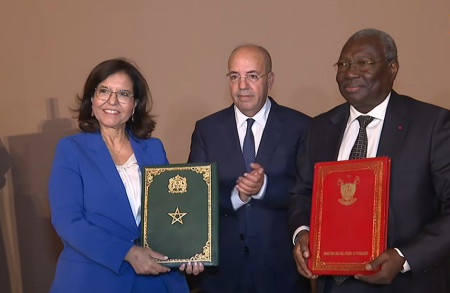
Cameroon and Morocco have signed a new framework cooperation agreement in the fisheries and aquaculture sectors, opening a fresh phase of economic collaboration aimed at raising fish production, improving food security, expanding trade and strengthening controls against illegal fishing. The deal was signed recently in Meknès, during the 18th International Agriculture Show in Morocco (SIAM), where both governments moved to deepen ties in a sector seen as strategic for jobs and regional growth.
The agreement was signed by Morocco’s Secretary of State for Maritime Fisheries, Zakia Driouich, and Cameroon’s Minister of Livestock, Fisheries and Animal Industries, Dr Taïga, in the presence of Morocco’s Agriculture Minister Ahmed El Bouari. It establishes a structured framework for cooperation covering development, preservation and governance of fisheries resources, while also promoting bilateral economic partnerships.
Priority areas include professional training, scientific research, stock monitoring, sustainable aquaculture, seafood product processing, marketing and action against illegal, unreported and unregulated fishing. These areas are central to improving yields, limiting losses and increasing the commercial value of fish products.
“This agreement today will provide the legal framework for us to continue working, because the work has already begun. We will strengthen cooperation in scientific research, training, control measures against illegal fishing and the marketing of fisheries products,” Zakia Driouich said.
According to Cameroonian officials, Moroccan institutions had already hosted Cameroonian technicians, while Morocco had taken part in Cameroon’s first international aquaculture fair. The new agreement formalizes those contacts and broadens them into a longer-term programme.
Signatories identify technical support for aquaculture as a key commercial lever. Expanding fish farming reduces reliance on wild catches, stabilises prices, and creates opportunities across the value chain—feed production, hatcheries, cold storage, logistics, and retail distribution. It also enables inland production, easing pressure on coastal zones.
Surveillance and enforcement are another core priority. Illegal fishing erodes state revenues, undermines licensed operators, and depletes fish stocks. Strengthened monitoring systems and regulatory cooperation deliver direct fiscal gains and improve market conditions.
“We have just signed a very important agreement, a technical cooperation accord that should help us share experience in training and support. This signature allows us to deepen that technical cooperation and continue the work already started,” Dr Taïga said.
He added that Cameroon could draw on Morocco’s experience in surveillance systems to strengthen the fight against illegal fishing. That could be particularly relevant as African coastal states seek better control of maritime resources and more transparent fisheries management.
The two governments also confirmed plans to create a joint commission to monitor implementation and evaluate agreed actions. Such follow-up mechanisms are often key in turning framework agreements into operational projects, investment programmes and measurable trade outcomes.
Beyond fisheries alone, the pact aligns with broader African efforts to develop the blue economy, where oceans, inland waters and related industries are treated as engines of growth. This year’s SIAM event was on the theme: “Sustainability of Animal Production and Food Sovereignty”.
Mercy Fosoh

