















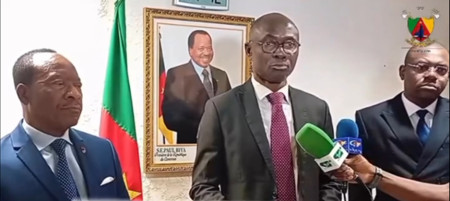
Cameroon is accelerating preparations for the development of the Douala-Bangui corridor, with the government and the World Bank aligning on timelines and financing ahead of a targeted approval date of June 2026. The Minister of Public Works, Emmanuel Nganou Djoumessi, chaired a high-level meeting in Yaounde on 10 April with a World Bank delegation led by senior specialist Alphonse Soh to review preliminary findings on the project.
Discussions indicate that project preparation is at an advanced stage, with both parties confirming progress on technical and procurement aspects. The Yaounde-Edea section, spanning 165 kilometres, has been identified as the most mature component and is expected to form the first phase of implementation.
“The preparation of the project is well advanced and that is to the credit of the government. This allows us to be confident that the deadlines expected of us, notably approval before the end of June 2026, will be met,” said Alphonse Soh.
The World Bank is considering a financial contribution of approximately $400 million, equivalent to over CFA220 billion, towards the project. However, the institution has indicated that it will not finance the entire Cameroonian section of the corridor, pointing instead to a broader funding structure involving multiple development partners.
“We are working to determine the needs required for rehabilitation works on the section where we are engaged. It is not the World Bank that will finance the entire Cameroonian section of the corridor, there are other donors, and discussions are ongoing,” said Soh.
Other partners involved in the financing framework include the French Development Agency, the European Union, the European Investment Bank and the Islamic Development Bank, reflecting the scale and regional importance of the infrastructure programme.
Alongside new construction, discussions also covered the maintenance of Cameroon’s road network, estimated at approximately 11,000 kilometres. The World Bank has signalled its readiness to support ongoing maintenance operations, particularly on the Ayos–Garoua-Boulaï axis, pending more extensive rehabilitation works.
The government has placed emphasis on strengthening the National Park of Civil Engineering Equipment, MATGÉNIE, the state-owned company responsible for road maintenance, as part of efforts to improve execution capacity. Upcoming technical meetings are expected to refine the national road maintenance strategy and align it with modernisation objectives.
“Road maintenance will be at the heart of the road strategy in the coming years. The World Bank stands ready to support the state once this strategy has been adopted,” Soh stated.
The Douala-Bangui corridor project is considered one of the largest infrastructure undertakings currently under preparation in Cameroon, with works expected to span multiple sections and phases. Procurement processes are nearing completion, with tender documents being finalised to enable rapid contract signing once financing is secured.
“Once the funds are available, contracts will be signed and works will start quickly,” Soh said.
The corridor connects Cameroon’s economic capital Douala to Bangui in the Central African Republic, positioning it as a key regional trade route. Its development is expected to facilitate cross-border movement of goods and strengthen economic integration within Central Africa, while addressing longstanding infrastructure constraints along the route.
Mercy Fosoh

