





























Cameroon has increased its borrowing for urban video surveillance to CFA150.8 billion after President Paul Biya on December 17, 2025 signed a decree authorizing the minister of economy, Alamine Ousmane Mey, to contract a new loan of CFA39.2 billion from China Citic Bank Corporation Ltd. According to the presidential decree, the funds will be used for “additional financing of the national expansion project of the intelligent urban video surveillance system.”
With this new financing, the government is preparing to secure a fourth loan for the project from three Chinese lenders, bringing total funds mobilized over eight years to CFA150.8 billion. The first phase was financed through a CFA45.9 billion loan granted by Bank of China, following an authorization decree signed on June 19, 2017.
A second loan of CFA32.8 billion was approved in March 2024 for phase II of the project through Banco Santander in Hong Kong, after China Construction Bank Corporation withdrew in 2021. A third credit of CFA32.8 billion was contracted on December 2, 2024, again with China Citic Bank Corporation Ltd. The fourth loan, authorized on December 17, 2025 with the same bank, comes amid rising urban insecurity and security crises along several of the country’s borders.
According to the authorities, the first phase of the project led to the installation of 1,500 surveillance cameras in several Cameroonian cities. The system was complemented by 2,000 portable transmitter-receiver units aimed at improving police monitoring and response capacity.
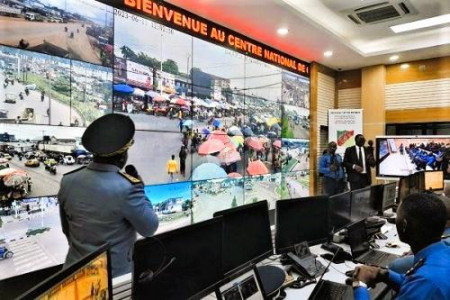
Two command centers were also set up in Yaounde and Douala under the supervision of the General Delegation for National Security, to ensure better coordination of operations and centralized management of images and alerts generated by the system.
Phase I targeted the capitals of Cameroon’s ten regions as well as several locations considered strategic. These include Kribi, home to the country’s largest port, as well as Kye-Ossi and Garoua-Boulai, two border towns with Equatorial Guinea and the Central African Republic.
The second phase aims to densify the national network of cameras and related equipment. The stated objectives include improving security, combating crime and terrorism, monitoring traffic, and managing emergency responses, through the deployment of additional “smart” cameras and supporting infrastructure.
The intelligent video surveillance system is intended to equip Cameroonian cities with enhanced security tools to better address insecurity. The project also covers areas particularly exposed to Boko Haram attacks, such as Waza, Fotokol, Kousseri, and Amchide, in the Far North region.
By combining cameras, portable communication tools, and command centers, the authorities aim to strengthen prevention, deterrence, and response capabilities to security threats in urban centers and sensitive border areas.
Frédéric Nonos

