






















Cameroon has issued a set of financial and environmental requirements that Chinese mining companies must meet before suspended gold extraction operations in the East Region can resume.
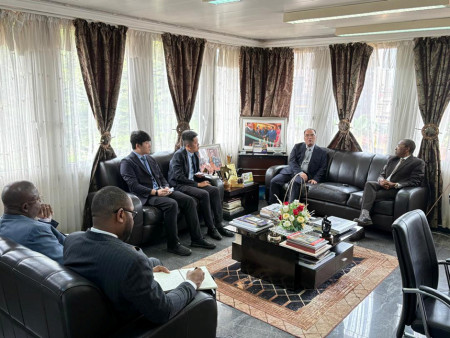
The conditions were formalised during a high-level meeting, on April 10, in Yaoundé between Interim Minister of Mines, Industry and Technological Development, Prof Fuh Calistus Gentry, and Li Jiang Hua, Political Counsellor of the Chinese Embassy in Cameroon. The talks built on an earlier awareness session held with Chinese Embassy representatives and executives from several Chinese-owned gold mining companies in the East Region, following a wave of site closures targeting operators found in breach of Cameroon’s Mining Code.
To have their suspensions lifted, companies must satisfy three binding conditions: pay an environmental bond of 63 million CFA francs, calculated at 3 million CFA francs per hectare, declare a minimum monthly gold production of five kilograms per operating unit of five production bowls, and complete a full transition to a closed-circuit processing system within six months.
The environmental bond requirement alone sets a significant financial threshold. For multi-hectare operations, compliance costs accumulate sharply, effectively excluding undercapitalised and informal operators from the path to reinstatement.
During the meeting, Li Jiang Hua reiterated that Chinese firms operating in Cameroon must comply fully with local mining regulations. China also reaffirmed its support for Cameroon’s broader effort to restructure and formalise the semi-mechanised artisanal mining sector, an industry whose informal nature has long undermined State revenue collection and environmental oversight.
Prof Fuh was explicit that the closure of illegal mining sites in the East Region is not directed exclusively at Chinese-owned operations, stressing that all operators regardless of nationality are subject to the same legal framework. The minister nonetheless acknowledged China’s standing as a strategic partner, while drawing a clear line: bilateral economic relations must rest on full respect for Cameroonian law to remain mutually beneficial.
Both sides agreed that formalising the sector serves the interests of all stakeholders, the State, investors, and local communities, by creating a more transparent, accountable, and environmentally regulated operating environment.
Prof Fuh also granted the Chinese authorities present an additional one-week deadline to intensify awareness efforts among their nationals currently engaged in illegal mining activities in the region.
The East Region holds significant alluvial gold deposits and has for years attracted both licensed operators and informal miners, including a sizeable number of Chinese nationals. Full formalisation would allow the State to recover environmental bond revenues, production royalties, and tax receipts currently lost to unlicensed operations.
Mercy Fosoh

