



























Cameroon may renegotiate key power generation contracts after the planned acquisition of Globeleq’s stakes in the Kribi and Dibamba thermal power plants, a move the government believes could significantly reduce costs across the electricity sector.
According to a restructuring plan prepared in March 2026 by the Ministry of Water and Energy, the contracts linking former utility company ENEO — now renamed Socadel — to independent producers KPDC and DPDC currently cost nearly CFA8 billion a month.
Government officials hope to reduce that burden by about CFA3 billion monthly through new contract terms and changes to the operation of both facilities.
Two Strategic Power Plants at the Center of Talks
Discussions over Globeleq’s possible exit from the Cameroonian market have advanced in recent months.
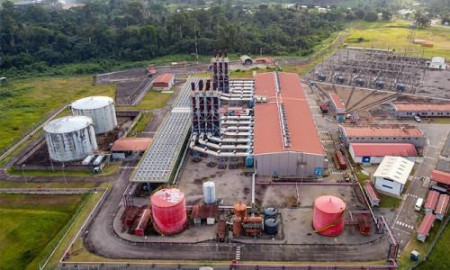
According to several sources, formal negotiations opened in early March between the government and representatives of the British power company over the possible sale of the 216-megawatt Kribi gas-fired plant and the 88-megawatt Dibamba heavy-fuel plant.
Globeleq Cameroon owns 56% of both facilities, while the Cameroonian state holds the remaining 44%.
Together, the two plants account for more than 20% of the capacity of the country’s Southern Interconnected Grid, which supplies electricity to Douala, Yaoundé and the industrial port zone around Kribi.
Because of that role, control of the assets carries strategic importance far beyond ownership structure alone and directly affects electricity supply security in Cameroon’s largest consumption areas.
The Main Issue: Costly Power Contracts
At the center of the negotiations lies the cost structure tied to the two plants.
According to the ministry’s restructuring plan, former utility operator ENEO currently pays about CFA8 billion a month in capacity charges under contracts signed with KPDC and DPDC.
Under the scenario being studied by the government, acquiring Globeleq’s shares would create room to renegotiate those agreements.
Officials estimate potential savings at around CFA3 billion a month.
The same document also refers to possible optimization or expansion of generation capacity at both sites in an effort to reduce broader electricity system costs.
In practical terms, the state does not appear to seek only control of the assets themselves, but also a deeper overhaul of the economic model governing their operation.
A Broader State Takeover of the Power Sector
The negotiations fit into a wider strategy by Cameroon to expand public control over the electricity sector.
After buying Actis’ stake in ENEO in a deal estimated at about CFA78 billion, the government’s potential acquisition of Globeleq’s assets would further strengthen state influence over power generation.
Transmission infrastructure already falls largely under Sonatrel, while the Electricity Development Corporation, known as EDC, oversees dam operations.
Viewed together, the Globeleq talks mark another step in the gradual restructuring of Cameroon’s electricity industry and the return of state control over key parts of the sector.
From Blocking a Sale to Pursuing Full Control
Yaoundé’s interest in the Kribi and Dibamba plants began well before the current negotiations.
On July 5, 2025, the government exercised its preemption rights to block the sale of the assets to another buyer.
At the time, British company Savannah Energy — already involved in the Bini à Warak hydroelectric and solar project — had expressed interest in acquiring the plants.
The government’s approach has since shifted from preventing the assets from leaving state influence to actively pursuing ownership and restructuring the contracts tied to them.
One major question remains unresolved: the price.
Neither the valuation of Globeleq’s holdings nor the timetable for concluding negotiations has been disclosed publicly.
After the financial effort already required to acquire ENEO, the government now faces pressure to show it can absorb another major transaction without further weakening the financial balance of the electricity sector.
Beyond the strategic value of the Kribi and Dibamba plants, the long-term financial sustainability of Cameroon’s broader power sector restructuring now hangs in the balance.
Amina Malloum

