




























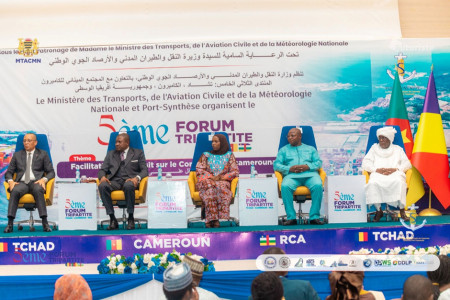
Transport ministers and logistics operators from Chad, Cameroon and the Central African Republic (CAR) have convened in N’Djamena for the fifth edition of the Tripartite Shippers Forum. The three-day summit aims to reduce cargo transit delays, lower logistics bottlenecks and strengthen the competitiveness of the Transcameroon Corridor, which links the ports of Douala and Kribi to landlocked Central African markets.
The forum, organised by the Shippers Council of Chad (COC-TCHAD) in partnership with Cameroon’s Port Synthèse community and running from May 11 to 13, 2026, brings together port authorities, customs administrations, transporters, freight forwarders and exporters. Its central theme is the facilitation of transit on the Transcameroon Corridor, which links the ports of Douala and Kribi in Cameroon to N’Djamena in Chad and Bangui in the CAR.
Opening the forum on May 11, Chad’s Minister of Transport, Civil Aviation and National Meteorology, Fatimé Goukouni Weddeye, said the discussions would assess implementation of resolutions adopted during the previous edition held in Kribi in January 2024, while identifying constraints still affecting transit fluidity and corridor competitiveness. According to her, reforms had been introduced in recent years to modernise procedures, reinforce corridor security, reduce cargo delivery times and improve logistics governance.
She cited the 2026 report of the Observatory of Abnormal Practices on Central African Corridors, which records a significant reduction in the number of checkpoints on Chadian territory between 2021 and 2026. The Chadian Minister further called for the interconnection of information systems across the three countries and for further digitalisation of transit procedures and logistical chain governance.
“It is up to us to build a transport and transit system that is more modern, more secure, more efficient and better adapted to the demands of regional and international trade,” she said at the opening.
According to the Chadian minister, authorities in Chad had also intensified measures to secure transport corridors and improve road traffic flows.
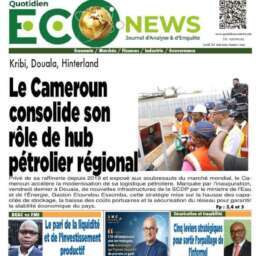
On his part, Cameroon’s Minister of Transport, Jean Ernest Masséna Ngallè Bibéhè, told participants that the Cameroonian government had undertaken several infrastructure and administrative measures to improve transit conditions for Chadian and Central African cargo operators.
The projects include the widening of the eastern exit of Douala towards Dibamba, expansion works at the Douala port container terminal and the completion of phase two of the Kribi deep seaport project. He also announced a 50 per cent reduction in GPS beacon fees applied to cargo monitoring operations. The Cameroonian minister further cited intensified anti-corruption controls, interministerial inspection missions along transit corridors and cargo monitoring reforms aimed at reducing bottlenecks affecting transport operators.
Corridor competitiveness under focus
Officials at the forum said transport costs, multiple checkpoints, administrative barriers and delays in cargo processing continue to affect regional trade competitiveness despite reforms introduced in recent years.
Cyrus Ngo’o, Director General of the Port Authority of Douala and President of Port Synthèse, said the port community platform created in 1994 had become a coordination framework linking transport and logistics operators from the three countries. He said the objective was to consolidate gains already achieved in cargo fluidity and facilitate trade exchanges through Cameroonian ports.
The representative of the Central African Republic’s Ministry of Transport stated that access to maritime corridors remained a strategic issue for Bangui because of the country’s landlocked position. He added that harmonisation of regulatory frameworks among the three states remained one of the major challenges facing corridor operations.
According to officials attending the forum, discussions are also focusing on digitalisation of procedures, interconnection of information systems and strengthening cargo security mechanisms.
Mercy Fosoh

