

















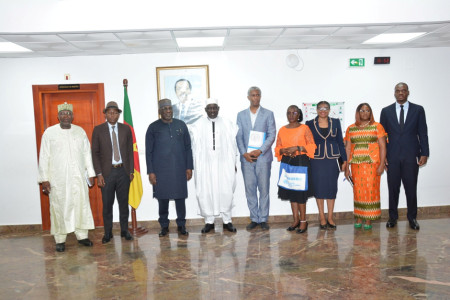
Economy Minister Alamine Ousmane Mey and World Health Organisation (WHO) officials discussed new domestic financing options for Cameroon’s health sector in Yaoundé as declining international development aid puts pressure on healthcare funding.
The talks, held at the Ministry of the Economy, Planning and Regional Development, brought together the minister and a WHO delegation led by Dr Magaran Monzon Bagayoko and Fabrice Laviolette.
Discussions focused on financing and governance reforms aimed at securing more sustainable investment flows for healthcare delivery as external donor support becomes increasingly constrained.
According to Dr Bagayoko, the discussions centred on redefining financing priorities to maintain investment in the sector despite shrinking official development assistance.
“We reviewed financing issues in light of declining official development assistance and the need to mobilise greater domestic resources to support health,” he said.
The discussions also covered “the key milestones in our partnership and the development of our new cooperation strategy with the government,” he added.
WHO officials also pushed for closer coordination between health authorities and economic planners as Cameroon aligns health financing with its National Development Strategy (NDS30), which identifies human capital development as a pillar of long-term economic growth.
“It is about seeing how better to align our financing strategy with the integrated health financing framework developed by the Ministry of the Economy under the implementation of SND30,” Dr Bagayoko said.
He added that the approach would strengthen cooperation beyond sectoral ministries and reinforce direct collaboration with MINEPAT.
The renewed focus on domestic financing comes as recurring public health emergencies continue to strain health systems across the region, increasing pressure on governments to improve preparedness and secure more predictable funding mechanisms.
The two sides also discussed universal health coverage, epidemiological surveillance, emergency preparedness and the One Health approach, which integrates human, animal and environmental health management.
The meeting forms part of a long-standing cooperation framework between Cameroon and WHO dating back to a base agreement signed in 1962.
Under WHO’s Country Cooperation Strategy for 2025-2029, aligned with Cameroon’s NDS30, Cameroon could benefit from several strategic financing instruments, including the Pandemic Fund estimated at about CFA14.1 billion.
The fund is intended to strengthen national preparedness and response capacity for future health crises while supporting the resilience of public health infrastructure.
Officials said the latest exchanges reflect a broader effort to build a more self-sustaining health financing model capable of reducing dependence on external aid while protecting investment in public health and economic productivity.
Mercy Fosoh

