





























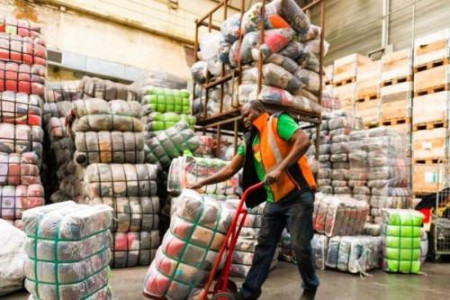
(Business in Cameroon) – Imports of used clothing into Cameroon rose sharply in 2024, both in volume and value, highlighting how deeply the sector has become embedded in everyday consumption.
Data from Cameroon’s National Institute of Statistics (INS) show that the country imported 72,600 tons of second-hand clothes worth 39.8 billion CFA francs ($64.8 million) in 2024, up from 61,221 tons valued at 30.2 billion CFA francs in 2023 , an 18.6% increase in volume and a 31.8% rise in value.
The surge reflects mounting pressure on household purchasing power, with used clothing, known locally as friperie, now the most affordable option for millions of consumers. The trade supports a vast network of importers, wholesalers, and market vendors that sustain thousands of families across the country.
Local Industry Loses Ground
The boom in used clothing has coincided with a steep decline in Cameroon’s cotton, textile, and garment industry. Official data show that local manufacturers now control less than 5% of the national fabric market, according to industry sources, losing ground to cheaper imports often linked to smuggling and low-cost textiles. The result has been factory closures, idle industrial capacity, and job losses.
To reverse the trend, the government has made reviving the textile sector a priority under its National Development Strategy 2020-2030 (SND30). Targets include boosting cotton production to 600,000 tons a year and processing half of it locally by 2030 to rebuild a competitive textile value chain.
The plan focuses on two areas. The first is producing uniforms for the defense, security, and civil service sectors, using 60% locally grown cotton. The second involves expanding sportswear production to meet at least 50% of domestic demand. Meeting these goals could cut import dependence and create new opportunities for local producers.
Success, however, will depend on broader structural reforms , modernizing farming and manufacturing, improving logistics, widening access to finance, and tackling fraud and smuggling.
It will also require a consistent industrial policy to attract investment in dyeing, spinning, and garment manufacturing. Without such reforms, the second-hand clothing market is likely to keep expanding , often at the expense of domestic industry.
Amina Malloum

