
















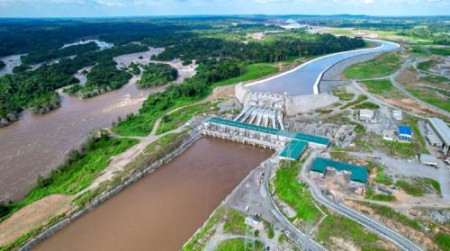
Cameroon’s Electricity Sector Regulatory Agency (ARSEL) has shortlisted three candidates to audit the financial models of Nachtigal Hydro Power Company (NHPC), which operates the Nachtigal hydropower plant. They are CPCS, KPMG Central Africa and the Grant Thornton Conseil-BBI Advisory & Audit consortium, according to a statement signed on July 30, 2026.
The candidates will be invited to submit technical and financial bids through a restricted tender process. The tender is funded from ARSEL’s 2026 budget. It follows a call for expressions of interest launched on June 30, 2026, and is separate from the preliminary process initiated in September 2025.
The selected consultant will review the financial models prepared at the project’s financial close, subsequent versions and the latest model available when the audit begins. The aim is to assess their compliance with contractual requirements, the consistency of their assumptions and their financial soundness.
Debt, Returns and Tariff Implications
The audit will cover investment and operating costs incurred, debt drawdowns, interest accrued during construction, changes to the project schedule and power generation assumptions.
The consultant will also analyze the financing structure, cash flows, the project’s overall return and returns to shareholders, the cost of capital and the impact of changes in interest rates, inflation and exchange rates. The terms of reference also require sensitivity tests and stress scenarios to assess the model’s resilience to adverse changes in those parameters.
For the regulator, the assignment goes beyond reviewing NHPC’s accounts. The audit must assess how the financial model affects the capacity charge and the price of electricity purchased from Nachtigal, as well as the financial burden on the Cameroon Electricity Company (Socadel) and the National Electricity Transmission Company (Sonatrel).
ARSEL aims to determine whether the project’s financial commitments are sustainable for the power sector and consumers. The selected firm will be required to identify any inconsistencies, financial weaknesses or departures from the power purchase agreement, the concession agreement and the financing agreements.
The audit comes as the electricity sector faces severe cash flow pressures. During a visit to Nachtigal on March 18, 2026, Water and Energy Minister Gaston Eloundou Essomba acknowledged payment difficulties involving NHPC and called for the sector’s finances to be put on a sounder footing.
A Separate Audit of Construction Costs
The shortlisting of CPCS, KPMG Central Africa and Grant Thornton Conseil-BBI Advisory & Audit is separate from the broader audit of Nachtigal’s construction cost.
On the same date, June 30, 2026, ARSEL launched a separate process to examine the development and construction costs of the hydropower facility. That assignment will verify the expenditures incurred, whether they complied with the concession specifications and whether the requirements of the construction contracts were met.
It will also assess costs incurred during the development and construction phases, drawing on technical, financial, legal, tax, accounting and environmental expertise. The assignment is expected to last 24 months.
The two audits are therefore complementary. The first will examine the project’s financial structure, debt, returns and tariff implications. The second will focus on whether expenditures incurred in developing and constructing the facilities were justified and complied with contractual requirements.
An Investment of About 800 Billion CFA Francs
Fully commissioned in May 2025, the Nachtigal plant has an installed capacity of 420 megawatts. By the end of May 2026, it had delivered more than 3 terawatt-hours of electricity to the national grid since phased commissioning began.
NHPC estimates the project’s cost at about €1.2 billion, or nearly 800 billion CFA francs. The financing structure consists of 24% equity and 76% loans from international development institutions and Cameroonian commercial banks.
EDF holds a 40% stake in NHPC, while the International Finance Corporation owns 20%. The Cameroonian government and Africa50 each hold 15%, while investment fund STOA owns the remaining 10%.
By auditing the financial assumptions that underpin investor returns and electricity prices, ARSEL is seeking to determine whether Nachtigal’s model remains contractually compliant and sustainable for a sector facing cash flow deficits. The findings could clarify Socadel’s and Sonatrel’s financial obligations, as well as how those costs may be reflected in future regulated tariffs.
Amina Malloum

