































Cameroon’s Land Freight Management Bureau (BGFT) on Feb. 20, 2026 launched the digitization of procedures for issuing the mandatory waybill (LVO) and collecting the axle tax in Douala. The reform was implemented in partnership with Chad’s National Land Freight Bureau (BNFT).
The LVO is mandatory for all commercial road freight operations. It ensures traceability and serves as contractual proof of carriage. The axle tax finances road maintenance. Authorities say the reform is designed to secure administrative procedures and revenue streams that are critical to sub-regional transit.
Two platforms underpin the new system: Landfreightis, an electronic freight exchange for Central Africa, and Sig Freight, a digital monitoring tool for land freight procedures. Carriers must now complete all procedures online through these interfaces.
Project lead Abdoullahi Faouzi said the reform has three objectives: simplify and increase transparency in procedures; secure revenue allocated to the Public Treasury and road maintenance; and ensure national control over sector data. BNFT Director General Saleh Youssouf Erda said agencies in Douala, Kribi and Ngaoundéré, as well as the Koutéré border post, are fully connected and operational.
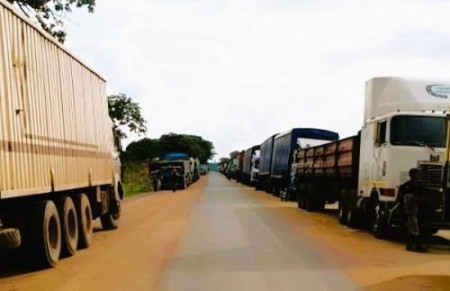
The reform comes amid persistent tensions along the 1,948 km Douala–N’Djamena corridor, a vital trade route for Chad’s economy. Transport operators have for years complained about repeated controls by law enforcement and customs officials. According to customs data, transit of Chadian goods generates more than 350 billion CFA francs (XAF) annually for Cameroon.
A field mission conducted by the BGFT’s Operational Surveillance Unit from Jan. 22 to Jan. 31, 2026 identified significant bottlenecks. Over a stretch of 1,392 km, inspectors recorded 64 control points, equivalent to one stop every 21.75 km. Officials describe the corridor as structurally congested.
Each stop increases fuel consumption, accelerates vehicle wear and raises operating costs. Roughly 20,000 truck movements are recorded each year toward Chad, representing more than one million tons of goods. The cumulative economic impact is substantial.
For a fleet of 1,000 trucks completing one round trip per month, delays amount to an estimated 48 hours per one-way journey. Fixed costs rise by around 15% per ton-kilometer. A truck delayed by repeated stops can lose up to five operating days per month, equivalent to 1.5 trips annually. Region-wide, carriers’ losses are estimated at several tens of billions of CFA francs.
BGFT General Coordinator El Hadj Oumarou said the next challenge is ensuring interoperability between digital systems. By linking platforms such as Guce, Camcis and Sip, authorities aim to reduce non-tariff barriers and shorten processing times at control posts. The objective is to strengthen Cameroon’s position as CEMAC’s primary maritime gateway, where border crossings no longer disrupt freight flows but are handled through streamlined digital procedures.
Beyond administrative reform, officials say the initiative is intended to preserve the corridor’s logistical competitiveness, a key factor for regional trade and the purchasing power of millions of Chadian consumers.
Frédéric Nonos

