






























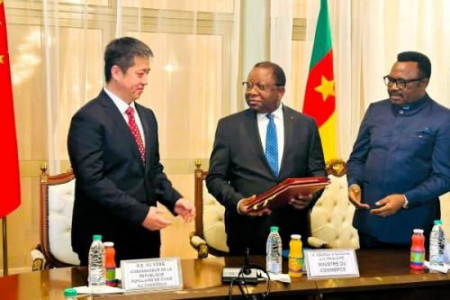
(Business in Cameroon) – Cameroon and China signed a framework agreement on December 10, 2025, in Yaoundé.
- The deal aims to expand market access, including duty-free entry for Cameroonian goods.
- Authorities hope it will improve competitiveness and reduce the trade imbalance.
On December 10, Cameroon’s Minister of Trade, Luc Magloire Mbarga Atangana, and China’s ambassador to Cameroon, Xu Yong, initialed a framework agreement in Yaoundé aimed at strengthening trade between the two countries. According to the minister, the deal marks “the first step in a process to build an economic partnership focused on market access, manufacturing development, and higher-value agriculture.”
The stated goal is to raise productivity and competitiveness of local products to help them integrate into global value chains. The next steps are expected to focus on granting Cameroonian goods duty-free access to the Chinese market, a prospect seen as attractive for local exporters. Authorities said further talks will cover smoother trade flows, more inclusive development, more resilient supply chains, and more modern business models.
Strong but imbalanced trade ties
The agreement builds on more than 50 years of bilateral cooperation. For over two decades, China has been Cameroon’s top trading partner and main supplier. In 2024, China led Cameroon’s imports—mainly machinery, mobile phones, and rice—with CFA535.1 billion, while ranking as the country’s second-largest export destination, notably for oil and gas.
Trade between the two countries exceeded CFA1,600 billion in 2024, including CFA1,100 billion in Cameroonian imports, according to the National Institute of Statistics. Despite this momentum, Cameroon continues to post a large trade deficit with China, estimated at CFA714.3 billion in 2023, up 18.5%.
With the framework agreement paving the way for duty-free access for Cameroonian products to the Chinese market, authorities hope to make imports and exports more affordable, improve business competitiveness, and further stimulate bilateral trade. The extent to which the deal can help reduce the structural trade imbalance in favor of local industries remains to be seen.
Frédéric Nonos

