

































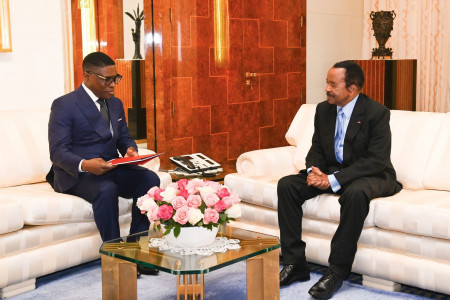
(Business in Cameroon) – The National Hydrocarbons Corporation (NHC) of Cameroon has presented progress on two major energy infrastructure projects to the visiting Vice-President of Equatorial Guinea, Teodoro Nguema Obiang Mangue. This was during meeting at the SNH headquarters in Yaounde on 19 November 2025. Presided over by Nathalie Moudiki, representing SNH’s Executive General Manager, the briefing showcased a US$198 million tank farm designed to secure national fuel reserves and a US$620 million modular refinery aimed at boosting domestic oil processing capacity.
Together, the projects form part of a US$818 million cross-border energy build-out linked to the Yoyo-Yolanda gas unitisation scheme and the CSTAR initiative, which seeks to reinforce regional cooperation, industrial development, and long-term energy security. Senior Equatoguinean officials and TRADEX executives from both countries participated in the session.
During the meeting, SNH recalled the bilateral commitments signed in March 2023 establishing the framework for the joint exploitation of the Yoyo-Yolanda field. Since then, technical teams from both states, alongside operators Noble Energy Cameroon and Equatorial Guinea of the Chevron group, have held multiple joint sessions to assess development scenarios and prepare the draft unitisation agreement. The most recent session in Yaounde in May 2025 recorded measurable progress on the technical and commercial parameters.
According to SNH’s technical briefing, work on the unitisation agreement has established the perimeter of the unitised zone and assessed recoverable resources. The field’s gas reserves are estimated at 2.5 Trillion Cubic Feet, TCF, of which 84% is allocated to Cameroon and 16% to Equatorial Guinea.
The selected development plan provides for the production of gas to be processed in both countries. Planned export routes include two pipelines: one to Cameroon’s Bipaga processing facility and one to the Alen field installations leading to Punta Europa in Equatorial Guinea. Processing at Bipaga and Punta Europa will yield condensates, liquefied petroleum gas, dry gas for liquefaction, and gas for Cameroonian industrial demand.
It emerged from the meeting that the agreement does not confer rights on maritime delimitation, and both parties indicated the need to resume discussions on defining the shared maritime boundary. Planned infrastructure within the project’s framework includes a natural gas processing platform within the Yoyo Production Sharing Contract, PSC area, three development wells and the dual-pipeline export system linking the two national value chains.
Beyond the upstream component, SNH presented the CSTAR-related investment roadmap comprising two major downstream projects: a strategic tank farm and a modular refinery. The tank farm is positioned as a core asset within Cameroon’s energy logistics system, designed to stabilise product availability and strengthen supply security.
The facility is planned to hold 100,000 metric tonnes of diesel, 100,000 metric tonnes of petrol, 30,000 metric tonnes of jet fuel and 20,000 metric tonnes of kerosene. The capital cost is estimated at US$198 million, with projected annual income of US$0.3 million against operating costs of approximately US$6 million. The internal rate of return is estimated at 10.5%, with a payback period of around ten years.
The modular refinery project forms the second major component of the downstream expansion. Estimated at US$620 million, the refinery is designed to process Cameroonian crude in its initial phase, with later stages allowing the integration of other grades. The projected product slate spans diesel to bitumen. Economic benefits are estimated at US$66 million per year, alongside wider gains through reduced imports of refined products, expanded industrial capacities and increased domestic value addition.
SNH confirmed that preliminary engineering studies, detailed design and early site works are underway. The 250-hectare site near the Kribi Deep-Sea Port has already been secured, and basic engineering studies have been completed. Work teams from India, China, Dubai and Cameroon are being deployed on site, with the foundation stone laid on 17 June 2025.
The corporation emphasised the expected economic impacts of both projects. The tank farm is projected to generate employment opportunities, stimulate logistical activity and strengthen cost stability across the petroleum supply chain. The refinery is expected to reduce import dependency, promote technology transfer, deepen industrial expertise and contribute to national GDP.
SNH also outlined the governance framework for the CSTAR, tank farm and refinery components, indicating that experienced national and international partners have been selected to support execution. The corporation highlighted the strategic value of these alliances in ensuring compliance with quality, safety and performance standards across all project phases.
Mercy Fosoh
