























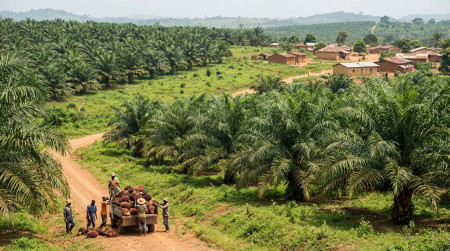
The Cameroon Palm Oil Company, SOCAPALM, has returned 2,566 hectares of arable land to the State at its Dibombari plantation in Moungo Division, Littoral Region. The restitution, made public on January 21, 2026, follows the completion of joint land demarcation and boundary-marking exercises and represents the first concrete outcome of a land clarification process underway for several years. The move reduces the company’s concession and formally restores the land to State ownership, with implications for land management and agricultural planning in the area.
The land return was announced during a tripartite meeting bringing together administrative authorities, SOCAPALM officials and representatives of local communities. As a result of the operation, SOCAPALM’s concession in Dibombari has been reduced from 11,210 hectares to 8,643 hectares, a cut of about 23%. The process followed technical surveys conducted on the site to clarify boundaries between the agro-industrial plantation and surrounding lands. Officials said the exercise was carried out in line with procedures governing long-term land leases between the State and private operators.
In a statement, SOCAPALM described the restitution as a voluntary return of unexploited land. “This voluntary return of unexploited areas is the starting point of a process that will gradually extend to all of our plantations. It reflects SOCAPALM’s commitment to working transparently with public authorities and local communities, in order to permanently clarify land issues that have in the past been a source of misunderstandings and local tensions,” the company said. SOCAPALM added that the initiative was launched in 2016 in collaboration with the State, land registry services, administrative authorities and local communities.
The Dibombari case is part of wider land-related claims involving SOCAPALM in the Littoral Region, where communities have raised concerns over access to land for farming and grazing. SOCAPALM maintains that the State remains the legal landowner. According to SOCFIN Group, SOCAPALM has identified close to 20,000 hectares, including 414 hectares in Edea, to be returned to the State out of more than 78,000 hectares initially leased, for eventual redistribution to surrounding communities.
Mercy Fosoh
