



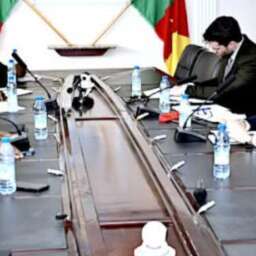








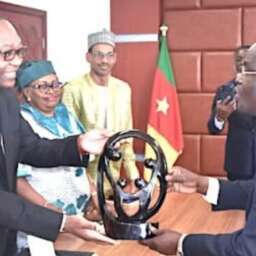


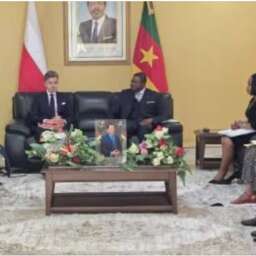










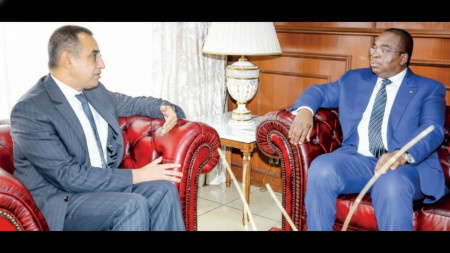
(Business in Cameroon) – The Minister of Finance, Louis Paul Motaze, has met in Yaounde with the Deputy Managing Director of Société Commerciale de Banque, SCB Cameroun, Ismaïl Douiri, to discuss expanded support for micro, small, and medium-sized enterprises (MSMEs). The talks focused on new avenues to strengthen professional organisations and accelerate the emergence of TPEs within the national economy. The meeting also reviewed the minister’s recent visit to Morocco, where he examined initiatives implemented by the Attijariwafa bank group to support small-scale entrepreneurship.
According to figures cited during the exchanges, MSMEs account for approximately 79.32% of the country’s small and medium-sized enterprises and generate around 91.81% of jobs, making them a central driver of employment creation and income generation. SCB Cameroun highlighted its entrepreneurship support model, including the “House of the Entrepreneur”, a training centre that provides project holders with tools for business development.
During the meeting, government reforms aimed at improving the business environment, such as reducing enterprise-creation costs, protecting intellectual property, and simplifying administrative procedures, were also referenced as part of broader efforts to strengthen the sector. Ismaïl Douiri stated that SCB Cameroun “acts as a driver of economic development” and emphasised that the bank “has put in place a concept that offers entrepreneurs the tools needed to develop their activities”. He added that the minister’s visit to Morocco allowed him “to observe the work carried out by the group in favour of TPE development, especially in training”.
The focus on MSMEs aligns with national strategies aimed at widening access to finance, supporting enterprise formalisation and reinforcing the competitiveness of small businesses. With MSMEs forming one of the most significant segments of the economic fabric, their growth has implications for regional job markets, poverty reduction and long-term financial resilience. The partnership discussions between the Ministry of Finance and SCB Cameroun, therefore, fit within broader regional trends of strengthening micro-business ecosystems through targeted training, financial facilitation and business-environment reforms.
Mercy Fosoh
