




























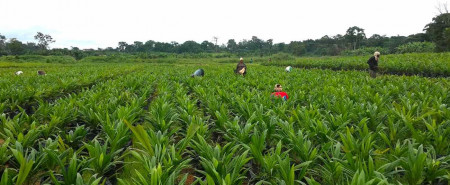
(Business in Cameroon) – The National Assembly of Cameroon has adopted Bill No. 2090/PJL/AN, establishing a legal framework for organic farming aimed at boosting Cameroon’s competitiveness in the €136 billion global organic market.
The bill was passed during a plenary sitting on 17 November 2025. The bill had been defended before the committee on 12 November by Agriculture and Rural Development Minister Gabriel Mbairobe and Minister of Livestock, Fisheries, and Animal Industries Dr. Taïga.
Comprising 62 sections across five chapters, the legislation defines organic farming as a system of crop cultivation, animal production, aquaculture, beekeeping, and forestry that preserves natural ecosystems, restricts synthetic chemical inputs, and excludes genetically modified organisms. It sets out rules for each farming method and introduces penalties for non-compliance.
Minister Mbairobe stated that the absence of regulation has hindered export performance, with several Cameroonian organic products intercepted and returned by the European Union over the past five years due to pesticide misuse. The new law aims to improve product quality, reduce health risks linked to contaminated food, and increase access to international markets.
According to government sources citing the Research Institute of Organic Agriculture (FiBL) and the International Federation of Organic Agriculture Movements (IFOAM), the global organic market has reached €136 billion, approximately FCFA 89.216 billion. Cameroon’s key organic exports include cocoa, coffee, cotton, fruits, vegetables, honey, pepper, sweet potato, beeswax, lemongrass, and shea butter.
Beyond trade, the law is positioned to support climate adaptation. A report from the National Observatory on Climate Change estimates agricultural losses due to climate variability between 1980 and 2022 at 6,71 billion FCFA, equivalent to over 24.22% of GDP. The bill promotes sustainable techniques such as greenhouse farming to mitigate future shocks.
During the plenary, eleven Members of Parliament raised questions to Minister Mbairobe, who responded with field-based assurances. “We try to sensitise farmers on the importance of organic farming and let them know what they can gain in terms of income, in terms of access to international markets,” he said.
Mercy Fosoh
