






























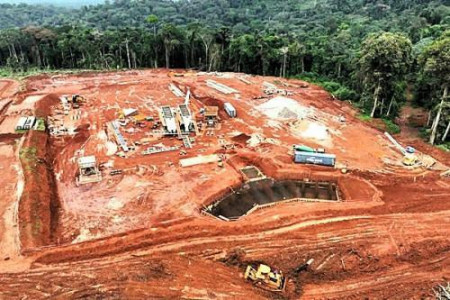
Australian mining group Sundance Resources Ltd has suffered a setback in its dispute with the Republic of Congo before the International Chamber of Commerce (ICC). In a statement released today, the junior miner said the arbitral tribunal, following a hearing held in Paris in November 2024 and post-hearing submissions, issued a final decision unfavorable to Sundance and its subsidiary Congo Iron.
According to the company, “a tribunal constituted under the ICC Arbitration Rules found that the Republic of Congo had a legitimate basis to revoke Congo Iron’s mining permit due to the failure to develop the project during the 2016–2018 period. As a result, all claims brought by Sundance and Congo Iron were dismissed.”
Sundance said its board, legal advisers, and litigation funder Burford Capital were “shocked” by the ruling. After reviewing the decision with the assistance of a London-based King’s Counsel, the company claims to have identified several serious irregularities that, in its view, resulted in substantial injustice to Sundance and Congo Iron.
The group argues that the ICC award is affected by serious procedural irregularities within the meaning of Section 68 of the English Arbitration Act 1996. On this basis, Sundance has filed an application before the High Court of Justice of England and Wales, Commercial Court, seeking to have the award set aside. Sundance and Congo Iron are represented in the proceedings by Clifford Chance and Siddarth Dhar KC of Essex Court Chambers.
Counteroffensive
Reacting publicly to the decision, Sundance’s non-executive chairman David Porter said the company was “shocked by this ICC award, which lacks sufficient reasoning.” He said the tribunal had made fundamental errors and did not allow Sundance to fully present its arguments on issues that later proved central to the tribunal’s decision-making process.
According to Porter, “the tribunal appears to have misunderstood fundamental aspects of how the mining industry and the iron ore market operate, and reached conclusions that were not based on the arguments put forward by the parties.” He nonetheless expressed confidence in the London proceedings, stating that “the English courts will set aside this award so that the serious injustice suffered by Sundance and its investors can be remedied.”
At the same time, Sundance provided an update on its separate arbitration proceedings against Cameroon, also before the ICC. A decision in that case is expected between February and March 2026. The company stressed that the Cameroon arbitration is independent from the Congo case, is being heard by a different tribunal, and should not be influenced or affected by the outcome of the Congo dispute.
The disputes stem from Sundance’s long-standing difficulties in advancing the Mbalam iron ore project. After several extensions of its exploration license, the group failed to secure technical and financial partners for the project’s key infrastructure. These included the construction of a railway of more than 500 kilometers linking Mbalam to the port of Kribi, the development of the mine itself, and the establishment of a mineral terminal at Kribi’s deep-water port. Talks with China Gezhouba in 2015, Tidfore Heavy Equipment Group Ltd in 2018, and later AustSino from 2018 all ended without agreement.
In 2021, Cameroon said it would turn to other partners to develop the project, including AustSino Resources Group Ltd and Bestway Finance. This shift has been contested by Sundance, which claims it was wronged by the Cameroonian state on the one hand, and by the Chinese group AustSino on the other. After negotiations with Sundance failed, AustSino signed a railway-related contract directly with the Cameroonian government on June 25, 2021, in Yaoundé.
Since August 17, 2022, Cameroon Mining Company Sarl (CMC), linked to Bestway Finance, has held the mining permit for the Cameroonian side of the Mbalam-Nabeba iron deposit. On the Congolese side, the project has come under the control of Sangha Mining, another subsidiary of Bestway Finance.
Amina Mallou
