



















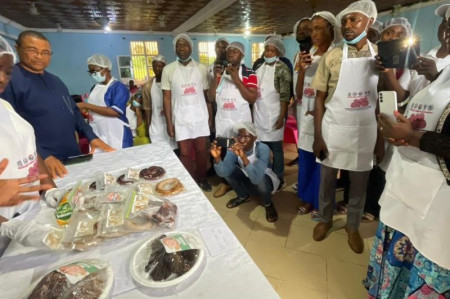
(Business in Cameroon) – The Institute of Agricultural Research for Development organised a three-day training session in Mbalmayo from 25 to 27 November 2025 to strengthen technical capacities in the pork value chain. The activity formed part of the Livestock and Fish Farming Value-Chain Development Project (PDCVEP), co-financed by the African Development Bank and the Government of Cameroon, and implemented with the Ministry of Livestock, Fisheries and Animal Industries, MINEPIA.
Around 30 actors from the pork sector were trained in innovative and sustainable processing techniques, including hygiene in charcuterie, stages of ham production, steps for preparing boudin, sausage processing, and methods for conditioning, packaging, and storing processed pork products. The initiative comes as national meat output fell by 36% in 2025 to 172,910 tonnes, with pork production sliding to 27,914 tonnes, ranking third behind cattle (68,902 tonnes) and poultry (38,914 tonnes) according to official figures.
According to published data, Cameroon produced 235,960 tonnes of meat in 2024, a 23.8 per cent decline from the previous year. Pork represented 39,676 tonnes of the national total in 2024. Further sector figures indicate that the pork market reached a value of 231 billion CFA francs in 2024, with a production volume of 77,000 tonnes, marking a 57 per cent. Cent increased compared with 2023. Separate national statistics also point to a pig herd estimated at 4,326,775 heads in 2023, an increase of 3.2 per cent from 2022, while pork output that year stood at 49,435 tonnes, a rise of 7.4 per cent.
During the workshop, the PDCVEP focal point at IRAD outlined the objective of enabling participants to master transformation techniques that align with food safety and nutritional requirements. The training covered practical steps that can support producers and processors in meeting established standards for processed meat, including measures intended to maintain hygiene, preserve product quality and ensure stable storage conditions.
The organisers stated that the increase in local consumption of processed pork products makes mastering transformation techniques essential for actors seeking to adapt to the expanding demand. They highlighted that improved transformation methods can support actors aiming to enhance the value derived from production activities, particularly in contexts where national meat availability is under pressure.
The Livestock and Fish Farming Value-Chain Development Project, implemented jointly by the Institute of Agricultural Research for Development, the Ministry of Livestock, Fisheries and Animal Industries, and the African Development Bank, seeks to modernise and improve the competitiveness of the cattle, pork, and aquaculture value-chains in Cameroon. The training in Mbalmayo is part of this broader objective to strengthen food security and enhance production conditions by developing capacity within the livestock sector.
Mercy Fosoh
