





















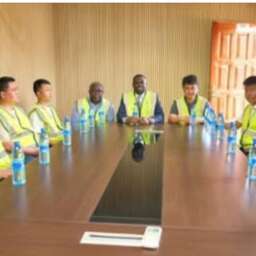
Hysacam (Cameroon Hygiene and Sanitation) and the National Center for Agricultural Mechanization Studies and Operations (Ceneema) signed an emergency technical partnership agreement late last year to address congestion at the Nkolfoulou landfill in Yaoundé and the PK 10 landfill in Douala. The bottlenecks had become a major logistical constraint for urban waste evacuation.
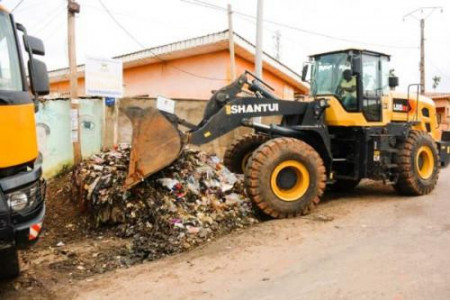
According to Hysacam, the agreement is based on temporary logistical support. Ceneema is providing technical expertise and deploying heavy equipment, including bulldozers and graders, to reorganize the sites and level accumulated waste. The operational goal is to clear saturated dumping areas and reduce waiting times that had slowed the rotation of waste collection trucks.
PK 10 reorganized while awaiting Ngombe at PK 21
On January 23, around ten pieces of Ceneema equipment were mobilized at the PK 10 landfill in Douala to open access routes and reorganize the site “for a few months.” Douala mayor Roger Mbassa Ndine said the site would later be converted into a “community forest and waste transfer center, once the Ngombe landfill at PK 21 becomes operational within four to six months.”
This timeline shapes the transition strategy: stabilize PK 10 in the short term while preparing a shift to a new landfill expected to come online within four to six months. In the meantime, the reorganization is mainly aimed at restoring processing capacity and limiting disruptions to waste collection.
The partnership comes amid a prolonged waste management crisis. Hysacam points in particular to financial strains that have delayed certain works. “We put solutions in place with government support, taking into account the cash flow difficulties caused by payment issues that had delayed the work,” said Jean-Pierre Ymele, Hysacam’s chief executive.
In this setup, Ceneema’s intervention is presented as emergency inter-institutional support. The mechanism is described as public operational assistance, with costs covered by state emergency budgets and by waste management fees already allocated to Hysacam by municipalities.
Daily volumes driving the need for new operators
Despite the additional support, pressure remains high. In Douala, daily waste generation is estimated at 2,700 tons. To ease the burden on Hysacam, the city council said it has recruited the operator Genelcam to handle part of the waste starting in 2026.
In Yaoundé, where around 2,000 tons of waste are produced each day, Hysacam says it recently secured contracts worth CFA45.7 billion to resolve the waste crisis over five years. In this context, cooperation with Ceneema is described as an emergency measure to stabilize treatment centers while cities gradually decentralize part of waste collection through new operators.
Frédéric Nonos
