






























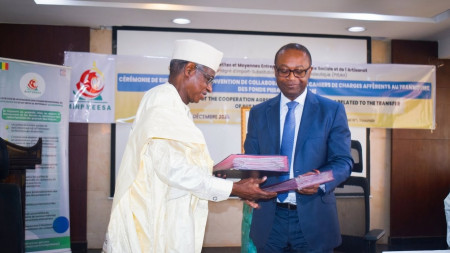
(Business in Cameroon) – Cameroon has stepped up efforts to strengthen domestic production and curb its rising import bill. The Ministry of Small and Medium-sized Enterprises, Social Economy and Handicrafts (MINPMEESA) confirmed the transfer of 1.5 billion FCFA to the SME Bank (BC‑PME) on 4 December 2025. The agreement, signed in Yaounde by Minister Achille Bassilekin III and BC‑PME Deputy Director General Amadou Haman, forms part of the government’s Integrated Agro‑Pastoral and Fisheries Import‑Substitution Plan (PIISAH), according to official statements from both institutions.
According to MINPMEESA, the 1.5 billion FCFA package has been allocated to strengthen production capacity across agro‑pastoral and fisheries value chains. Three hundred thirty million FCFA will support individual agro-food processing units, 930 million FCFA will establish three pilot collective processing units, and 240 million FCFA will supply modern palm oil presses for cooperatives. Officials stated that the funding is designed to accelerate PIISAH’s implementation, focusing on reducing import dependence, expanding local processing, and improving competitiveness for small and medium‑sized enterprises.
Under the agreement, BC‑PME is tasked with selecting SMEs, microenterprises and Social Economy organisations capable of contributing to PIISAH’s objectives. The bank must distribute the funds at a subsidised interest rate capped at 4% VAT included, a measure intended to ease access to credit for small operators. BC‑PME is also required to apply a monitoring and evaluation mechanism defined in the agreement. According to MINPMEESA, this system will ensure transparent fund management and continuous assessment of the financing’s impact on production, processing capacity and job creation.
MINPMEESA has announced that the financing programme will continue in 2026, with 1.6 billion FCFA expected to be allocated next year. The ministry stated that the additional funding will broaden sector coverage and further increase the productive capacity of SMEs in agro‑pastoral and fisheries activities. Officials emphasised that the long‑term objective is to reinforce economic resilience by supporting local value creation and reducing reliance on imported goods.
According to ministry documentation, the partnership with BC‑PME forms part of a broader national strategy to build a competitive and inclusive economy. SMEs are positioned as central actors in this strategy, particularly in sectors that generate employment and stimulate rural development. Authorities stated that the initiative represents a coordinated effort between government and financial institutions to strengthen the national economic fabric and support entrepreneurship as a driver of structural transformation.
MINPMEESA also confirmed plans to launch a dedicated youth financing window at BC‑PME. The facility will target young entrepreneurs seeking funding for projects in agriculture, craftsmanship and the social economy. According to the ministry, the measure aims to expand youth participation in national economic development and support job creation for future generations.
Mercy Fosoh
