
































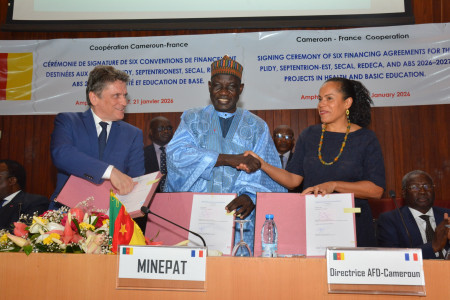
Cameroon and France have deepened their development partnership with the signing of six major financing agreements worth more than FCFA123 billion, targeting key sectors of the economy and social infrastructure. The agreements, signed in Yaounde, are designed to support urban development, food security, women’s economic empowerment, health, education and decentralisation, with the stated aim of improving living conditions and strengthening inclusive growth across the country.
The agreements were signed by the Minister of the Economy, Planning and Regional Development, Alamine Ousman Mey, and the Country Director of the French Development Agency (AFD), Virginie Dago. The signing ceremony took place in the presence of the French Ambassador to Cameroon, Sylvain Riquier, alongside members of the Cameroonian government. The financing package combines loans and grants under ongoing bilateral cooperation frameworks between Cameroon and France.
The largest portion of the funding is allocated to urban development, with a loan agreement of FCFA98.4 billion dedicated to the Urban Flood Control Project in Yaounde and Douala, known as PLIDY. The project focuses on combating recurrent flooding in the two main cities, which has had economic and social impacts on households, transport networks and commercial activities.
In the area of food security, two grant agreements totalling about FCFA 6.6 billion will support food security projects in rural communities. The initiatives are aimed at improving agricultural productivity, strengthening local food systems and increasing the resilience of vulnerable populations. The programmes are expected to support farmers and rural households by enhancing production capacities and access to more sustainable agricultural practices.
Part of the cooperation package is also directed towards the economic empowerment of women entrepreneurs in the North, Far North, Adamaoua and East regions. The funding will support capacity-building initiatives to improve access to skills, financing, and sustainable income for women-led businesses, to strengthen their participation in local and regional economies.
Debt relief funds channelled to health and education.
Other agreements relate to the allocation of the third Contract for Debt Reduction and Development (C2D), valued at approximately FCFA18.4 billion. The funds will be used to finance sectoral budgetary support for health and basic education over the 2026-2027 period. The focus is on improving access to quality healthcare services and strengthening the public education system, particularly at the community level.
Additional financing under the cooperation package targets projects aimed at strengthening decentralisation in Cameroon. These projects are designed to reinforce local councils’ capacities, improve local governance, and support community-based development initiatives in line with national decentralisation reforms.
Speaking at the ceremony, Minister Alamine Ousman Mey called on all stakeholders to ensure the effective implementation of the projects so that they deliver tangible results for populations in the targeted areas. “We are long-standing partners, and we are working towards improving the living conditions of the population with the support of France,” he said, adding that about €188 million had been committed to projects in infrastructure, education, health and women’s entrepreneurship.
French Ambassador Sylvain Riquier described the agreements as reflecting a shared commitment between the two countries. “It’s basically a common will for France and Cameroon to try and better the living conditions of the population through entrepreneurship, through women’s empowerment, through food security and the fight against flooding,” he said.
The total financing package amounts to €188 million, equivalent to FCFA123 billion. The projects are intended to improve access to healthcare, strengthen public education, support local government and address structural challenges affecting economic development. Cameroonian authorities say the agreements are expected to contribute to reforms and deliver measurable improvements across multiple sectors nationwide.
Mercy Fosoh
