



















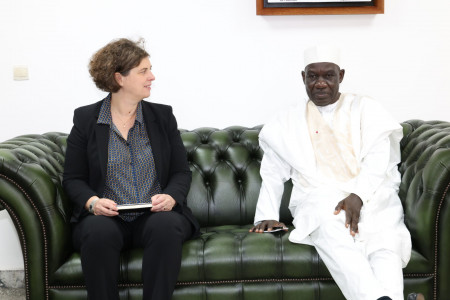
(Business in Cameroon) – Cameroon’s Ministry of Economy, Planning and Territorial Development and “Électricité de France” (EDF) have reaffirmed their shared commitments to delivering the country’s major hydropower projects as both sides reviewed progress on the Nachtigal Hydroelectric Dam, NHPC, and Kikot-Mbebe Dam, KHPC, facilities on 2 December 2025. The Minister Alamine Ousmane Mey met with an EDF delegation led by Bénédicte Regnier, Director for Africa of EDF Power Solutions, to discuss project delivery, partner obligations, and the government’s strategy to expand and diversify national energy sources.
The meeting comes months after the full commissioning in 2025 of the 420 MW Nachtigal Hydroelectric Plant, now providing close to 30 % of Cameroon’s electricity production capacity, according to operational data published in March 2025 by NHPC. Government documents identify Nachtigal as a flagship component of the National Development Strategy NDS30, which prioritises renewable energy expansion and the timely completion of significant infrastructure.
During the meeting, both parties assessed implementation milestones for the Kikot-Mbebe project, where the government has already secured 527 hectares of land required for construction, based on May 2025 disclosures from the Ministry of Economy, Planning and Regional Development.
The KHPC project company increased its capital from FCFA 100 million to FCFA 5.38 billion in 2025, according to regulatory filings confirmed by Business Finance International. These steps are part of the responsibilities allocated to shareholders and public authorities under the project framework and are designed to ensure financial readiness before major construction works.
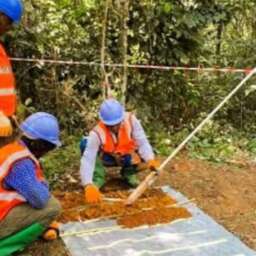
Technical preparations for Kikot-Mbebe have advanced, including procedures for selecting engineering firms and the launch of a tender for a 30 kV power supply line, as noted in 2025 sector updates. Once operational, the project is expected to supply 500 MW to the grid between 2031 and 2033, according to project partners and published energy sector briefings. This capacity would further diversify Cameroon’s generation mix by adding long-term hydropower output to complement existing thermal and hydro assets.
Officials stated that the Cameroon-EDF partnership remains central to achieving the country’s energy diversification goals, with each party required to meet the agreed-upon technical, financial, and regulatory obligations. The discussions focused on monitoring progress, maintaining delivery timelines and ensuring that commitments are fulfilled to support national energy targets under the government’s development strategy.
Progress on the KHPC-led initiative has unfolded rapidly through 2025, marked by competitive procurement and stakeholder engagements to mitigate social and logistical hurdles. In May, over 30 enterprises and consortia vied for construction contracts, reflecting strong global interest, with candidate preselection for the technical components finalised by November.
A landmark agreement in September 2025 between KHPC and Cameroon’s Ministry of Social Affairs, led by Minister Pauline Irène Nguene, established frameworks for monitoring and protecting communities displaced or affected by the project, emphasising social compliance and resettlement.
While President Biya announced an imminent launch in October 2025 during a public address in Maroua, official timelines project a 2027 groundbreaking and operational commissioning by 2031 or 2033, contingent on funding mobilisation. Challenges persist, including a saturated national transmission grid of 3,405 km—prompting regulatory shifts to attract private capital for electricity transport—and the need for coordinated international involvement, as evidenced by Canadian interest in adjacent Sanaga projects such as Minkouma.
Mercy Fosoh
