




















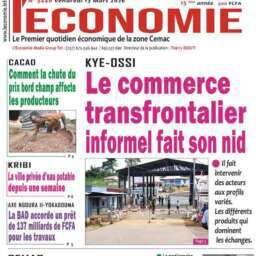











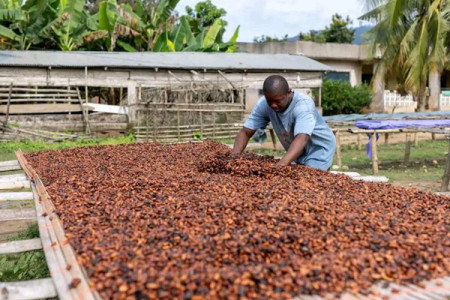
Cocoa prices in Cameroon have plummeted by as much as 75 per cent from their recent peak, with official figures from the National Cocoa and Coffee Board placing the Cost and Freight (CAF) price at 1,817 CFA Francs (XAF) per kilogram and the Free on Board (FOB) rate at 1,760 XAF per kilogram as of 16 March 2026. Farm-gate purchase prices in Douala ranged from XAF1,100 to XAF1,200/kg on the same date.
The figures mark a severe reversal from the record highs of XAF5,000 to XAF6,000/kg recorded during the 2023-2024 season, when poor harvests across West Africa triggered three consecutive years of global supply shortages. Prices in producing regions have since fallen to between XAF 1,050 and XAF1,500/kg, and analysts now warn of a sustained downturn.
Henri Kouam, Executive Director of the Cameroon Economic Policy Institute (CEPI), in an interview with Cameroon Insider attributed the collapse to a swift reversal in global supply fundamentals.
“There is now a surplus in the market, holding back prices. The market appears to be levelling off, contending with a situation of oversupply. The fragmentations in markets are causing new producers to come online, exacerbating the situation,” Kouam told Cameroon Insider.
Reports indicate that economic analysts anticipate a global production surplus of approximately 186,000 tonnes for the 2025-2026 season, with some traders projecting an overhang of 300,000 to 400,000 tonnes. Recovery in harvests in Ivory Coast and Ghana, combined with favourable weather and rising output from Ecuador, a country set to overtake Ghana as the world’s second-largest producer, has driven down international futures.
Demand has also weakened. High cocoa prices in 2024 is said to have prompted chocolate manufacturers to reduce bar sizes, increase the proportion of non-cocoa ingredients such as wafers and nuts, and substitute cocoa butter with alternative fats. Global grinding volumes fell by roughly five per cent as a result, shrinking the market for raw beans.
Cameroon, whose liberalised cocoa market exposes farmers directly to international price movements, has been harder hit than Côte d’Ivoire, where a government-stabilised pricing system shielded producers from the worst of the peak but also from the record highs Cameroonian farmers briefly enjoyed. Côte d’Ivoire has since cut farm-gate prices by nearly 60 per cent to avoid state budget deficits, while Ghana reduced its controlled price by around 30 per cent.
On the ground, the financial distress has prompted some Cameroonian farmers to abandon their plots or fell cocoa trees to plant food crops such as plantains and bananas. Kouam cautioned against this course of action, warning that cocoa is a multi-decade productive asset and that land cleared now risks permanent exclusion from European Union export markets under the EU Deforestation Regulation, which entered into force in June 2023.
Kouam called on the government to act on several fronts. He urged the Cocoa and Coffee Development Fund (FODECC) to accelerate disbursement of a XAF4 billion subsidy package earmarked for 2026, intended to help farmers cover the cost of inputs such as fungicides. He also proposed establishing a Price Stabilisation Reserve, drawing on taxes levied during boom years to underwrite a minimum farm-gate price during downturns.
On the export side, Kouam argued that Cameroon should capitalise on its Amsterdam Gold Medal win of February 2026 by fast-tracking the ‘Red Cocoa’ certification scheme. Premium fine-flavour beans command prices that bypass standard commodity exchange fluctuations, he said. He added that expanding local processing capacity, noting that Cameroon now processes over 100,000 tonnes annually, equivalent to 32 per cent of its crop, would reduce exposure to the volatility of raw bean markets in London and New York.
Mercy Fosoh
Read More:
02/03/2026- Cameroon Crosses 80% Cocoa Processing Mark as New 32,000-Tonne Plant Breaks Ground
26/02/2026- Cameroon Wins Gold at Global Cocoa Awards in Amsterdam
