






























All Bitumen PLC, the Cameroonian-owned company behind the planned bitumen production plant in Kribi, in the South region, has awarded the remaining technical studies to a consortium of four European firms: Austria’s Pöerner, Turkey’s Yamata, Germany’s EDL, and France’s Parlym. According to sources familiar with the matter, the group was preferred over a Chinese-led consortium headed by Zhihui Engineering Co. Ltd.
All Bitumen PLC chief executive Ahmadou Oumarou said the contract includes an option allowing the selected consortium to also carry out construction works, provided the final cost meets the company’s financial expectations. If not, he said the company reserves the right to seek another contractor. Should an agreement be reached on the overall cost, Pöerner and EDL would handle engineering works, Yamata would be in charge of plant construction, while Parlym would deliver pipelines as well as storage tanks and related equipment.
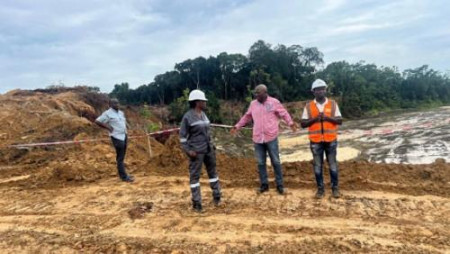
Originally scheduled to begin by the end of 2025, construction on the 60-hectare site allocated within the Kribi industrial-port zone is now expected to start in 2026. A delegation of project partners, including the chief executive of Pöerner and the chairman of Yamata, arrived in Cameroon on January 11 for a week-long visit and traveled to Kribi on January 14, 2026, to inspect the site. Clearing works have been completed for several weeks.
CFA2 billion allocated for earthworks
Completion of site clearing paves the way for large-scale earthworks. To finance these operations, the state has allocated CFA2 billion to the Kribi Port Authority under the 2026 finance law, according to an authorized source. The port authority is also responsible for making serviced land available to investors in the industrial-port zone.
The 2026 finance law also provides tax and customs exemptions on equipment required for construction, as well as on production inputs, to accelerate project implementation. “We welcome this government decision and thank the public authorities for involving us in defining the list of eligible equipment and inputs. We are now waiting for this list to be signed by the finance minister as planned, since construction works are set to start this year,” Oumarou said.
The Kribi plant is designed to produce 250,000 tons of bitumen a year and will be supported by a 10,000-barrel-per-day mini oil refinery supplying feedstock. Estimated to cost CFA161 billion, the project is expected to create between 300 and 400 direct jobs and around 1,500 indirect jobs.
Afreximbank to arrange financing
Financing is expected to be led by the African Export-Import Bank (Afreximbank). Since late 2024, the pan-African lender has held a mandated lead arranger role for the project, allowing it to participate directly in financing and mobilize additional partners. “The selected consortium will deliver what is known as an open-book cost estimate within nine weeks, which will allow us to determine the final project cost. After that stage, Afreximbank, which has the capacity to finance the entire project, will move forward with funding mobilization,” Oumarou said.
According to construction sector experts, the project could cut road construction costs in Cameroon by around 30%. This potential explains the strong backing from public authorities, who have committed to taking at least a 15% equity stake in the project. The initiative fits into the government’s strategy to expand the country’s paved road network to 11,300 km by 2027, up from 9,885 km in 2023.
In its medium-term economic and budgetary programming document prepared ahead of the 2024 budget policy debate in parliament, the government acknowledged that achieving this target requires support for domestic bitumen production.
Cameroon is regularly cited among African countries with the highest road construction costs. In 2013, during a meeting of the National Road Council, the average cost of building one kilometer of paved road was estimated at about CFA205 million, compared with an African average of CFA100 million. A World Bank report published in 2018 found that some road projects in Cameroon cost two to six times more than comparable projects elsewhere on the continent.
Authorities attribute much of this cost gap to the high price of imported bitumen, arguing that domestic production could help bring down infrastructure costs.
Brice R. Mbodiam
