
























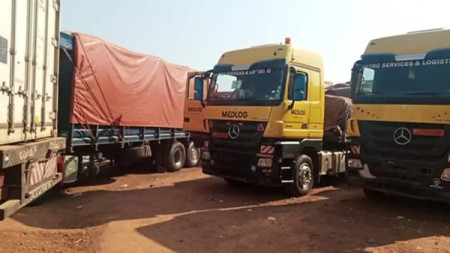
Illicit payments paid by truckers on Central Africa’s main trade corridors have fallen by half since 2021, while the number of checkpoints between Yaoundé and N’Djamena has declined from 104 to 79, according to findings presented on March 11 in Yaoundé by the Observatory of Abnormal Practices in Central Africa (OPA-AC).
The results were unveiled during a regional closing workshop attended by Cameroon’s Minister Delegate in charge of Planning, Paul Tasong.
The findings are based on 16 quarterly surveys conducted across the principal corridors of the Economic and Monetary Community of Central Africa (CEMAC), including the Douala–N’Djamena, Douala–Bangui and Yaoundé–Libreville routes, as well as port enclosures at Douala and Kribi.
The OPA-AC initiative is managed by the Sub-Regional Institute of Statistics and Applied Economics (ISSEA) and financed by the European Union under its Global Gateway programme. Its mandate is to identify and progressively eliminate trade barriers across the sub-region.
Among the main findings, traders on the Yaoundé–Libreville corridor paid approximately 250,000 CFA francs per 100 kilometres in illicit charges in 2021. By 2025, that figure had fallen to 125,000 CFA francs, representing a 50% reduction.
Progress has also been recorded in port operations. At the Port of Douala, vessel waiting times have dropped from between 14 and 15 days to eight, a change authorities attribute largely to the digitalisation of port procedures, which has also contributed to reducing the number of control points.
Along the 1,840-kilometre Yaoundé–N’Djamena corridor, only 46 of the 79 remaining checkpoints are considered active control points, including 40 on the Cameroonian side and six in Chad.
Professor Robert Ngonthe, deputy project leader of the OPA-AC, said the progress was encouraging but still slower than expected.
“We are moving towards intelligent port enclosures and corridors, even if it is not yet at the pace we had hoped.”
Minister Paul Tasong welcomed the study as a practical instrument for policy.
“All actors on the corridors agree that competitiveness is undermined by abnormal practices. To change the situation, there is nothing better than improving our understanding of these practices. We are at the heart of an instrument that works, that will work, and above all, a tool that is par excellence an aid to decision-making,” he said.
Philippe Lafosse, Chargé d’Affaires at the EU Delegation to Cameroon and Equatorial Guinea, framed the initiative within the bloc’s broader infrastructure and trade strategy.
“We are delighted to support this initiative because the EU works on growth based on the movement of people, goods, and assets. It is not enough to build infrastructure. People must also be able to move freely along these routes, in a predictable manner and without the harassment that consumers so often end up paying for,” Lafosse said.
The OPA-AC has also completed two surveys within the Douala port enclosure and one at the Autonomous Port of Kribi.
Marcel Opoumba, Director General of ISSEA and project leader of the OPA-AC, noted that conditions at port level had also improved significantly, though he did not provide figures during the workshop.
The findings come as CEMAC member states intensify efforts to boost intra-regional trade, which remains constrained by infrastructure deficits, bureaucratic delays and unofficial levies that increase the cost of goods for consumers across the sub-region.
Mercy Fosoh
